What Makes Steve Different From Traditional Ai Assistants
Jan 28, 2026

Persistent, Shared Memory: Shared memory keeps context across agents and sessions, reducing repetition and preserving project history.
Actionable Conversation via Steve Chat: Deep integrations and file-awareness let conversation trigger real-world actions across calendars, docs, and trackers.
Prompt-to-Product with Vibe Studio: Natural-language prompts convert into production-ready Flutter code and device previews, accelerating prototype-to-engineering handoff.
AI-Driven Task Management: Intelligent boards and sprint proposals turn decisions into trackable work that integrates with developer tooling.
Operational Continuity: Combining memory, conversational actions, code generation, and task orchestration transforms isolated replies into continuous execution.
Introduction
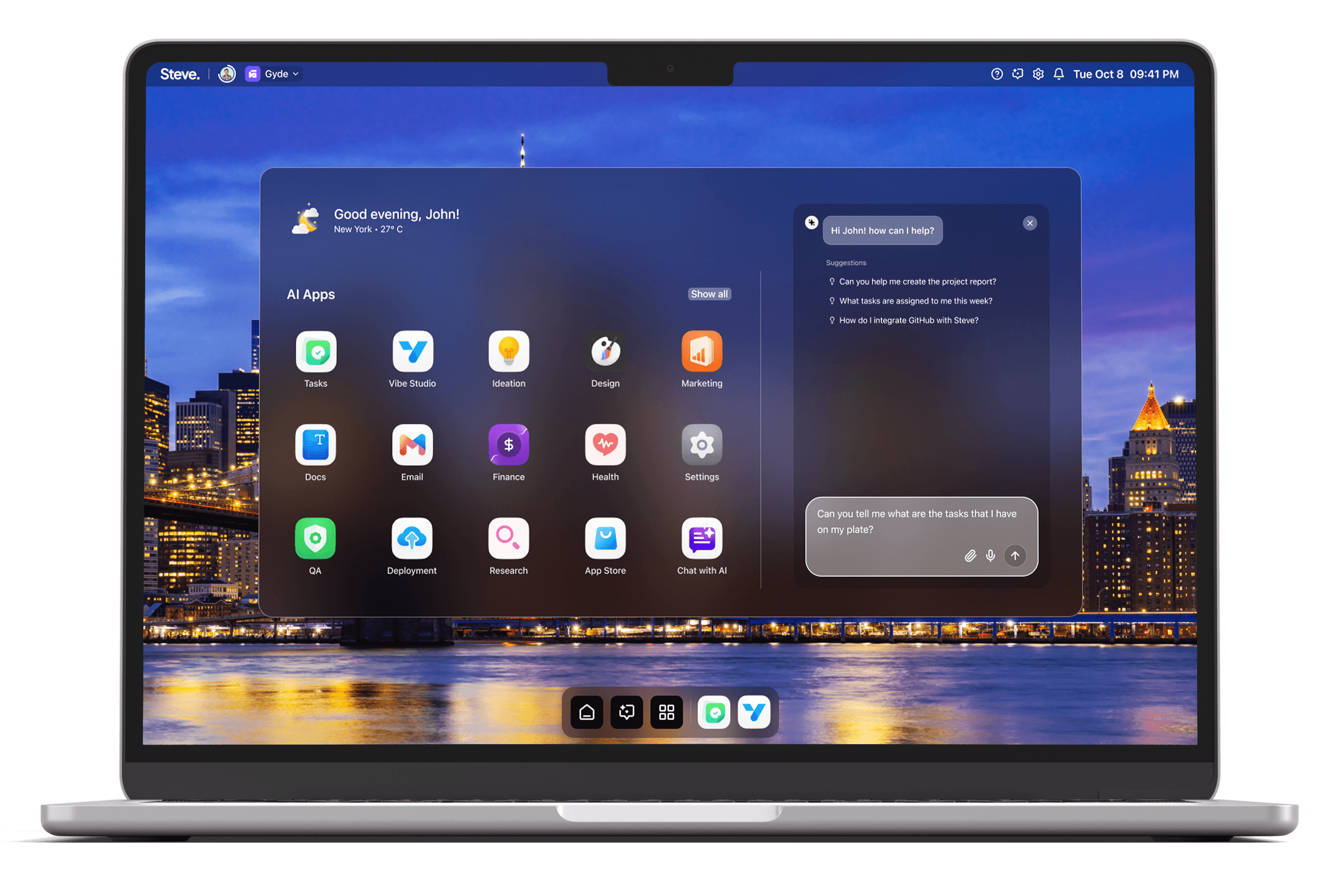
What makes Steve different from traditional AI assistants is scope: Steve is an AI Operating System built to orchestrate work across agents, code, and teams rather than only respond to discrete queries. Where conventional assistants focus on single-turn help or siloed chat, Steve unifies persistent context, deep application automation, and product-grade outputs so organizations can move from conversations to coordinated execution. This article explains how Steve’s shared memory, Steve Chat, Vibe Studio, and Task Management reshape what an AI OS can do for business workflows.
Persistent, Shared Memory That Keeps Work Coherent
Traditional assistants forget context between sessions or require users to repeat details; Steve uses a shared memory system so AI agents interact with and build on the same evolving context. That means decisions, constraints, and document references persist across conversations and modules, reducing repetition and errors. In practice, a product spec uploaded during a design conversation remains accessible to the engineering agent later, so task assignments or code generation respect original requirements without re-briefing. For teams, persistent memory turns fragmented inputs into a continuous project record, enabling multi-step workflows that feel like working with a human teammate who remembers prior discussions.
Conversational Automation With Rich Integrations (Steve Chat)
Steve Chat goes beyond single-threaded chat by combining conversational AI with deep integrations and file-awareness, enabling actions instead of just answers. Because Steve connects to calendars, email, Drive, Sheets, Notion, GitHub and more, a single dialogue can discover a document, extract data from a spreadsheet, and schedule a follow-up — all while preserving the contextual memory that powered each step. File uploads and real-time web searches enrich responses with current facts; integration hooks let the system execute scheduling or update issue trackers directly. This tight conversation-to-action loop eliminates tool switching endemic to traditional assistants, delivering practical outcomes from a single interface.
From Prompt To Production With Vibe Studio
Vibe Studio demonstrates how an AI OS produces deliverables, not just text. Rather than returning mockups or descriptions, Vibe Studio converts natural prompts into production-ready Flutter code, providing device-specific previews and an embedded development surface for iteration. For product teams, that capability compresses design and initial engineering into one collaborative flow: a PM describes an onboarding flow, Vibe Studio generates a working scaffold, and stakeholders interact with a live preview across mobile, tablet, and desktop. The output isn’t ephemeral; it becomes a tangible artifact engineers can refine, download, or push to GitHub, shortening the path from idea to deployable asset in ways a conventional assistant cannot.
Intelligent Task Management That Orchestrates Execution
Steve’s Task Management modules tie planning to execution by combining AI-powered boards with integrations and sprint suggestions. Instead of treating tasks as notes or reminders, Steve proposes structured sprints, imports or creates issues in tools like Linear, and keeps updates contextualized within the same shared memory. This changes the relationship between recommendation and execution: the system can propose priorities based on project context, convert decisions into actionable tasks, and keep the team aligned without manual translation. In practice, product leads receive AI-proposed sprint backlogs that reflect documented constraints and current repository status, accelerating planning cycles while preserving auditability and accountability.
Steve
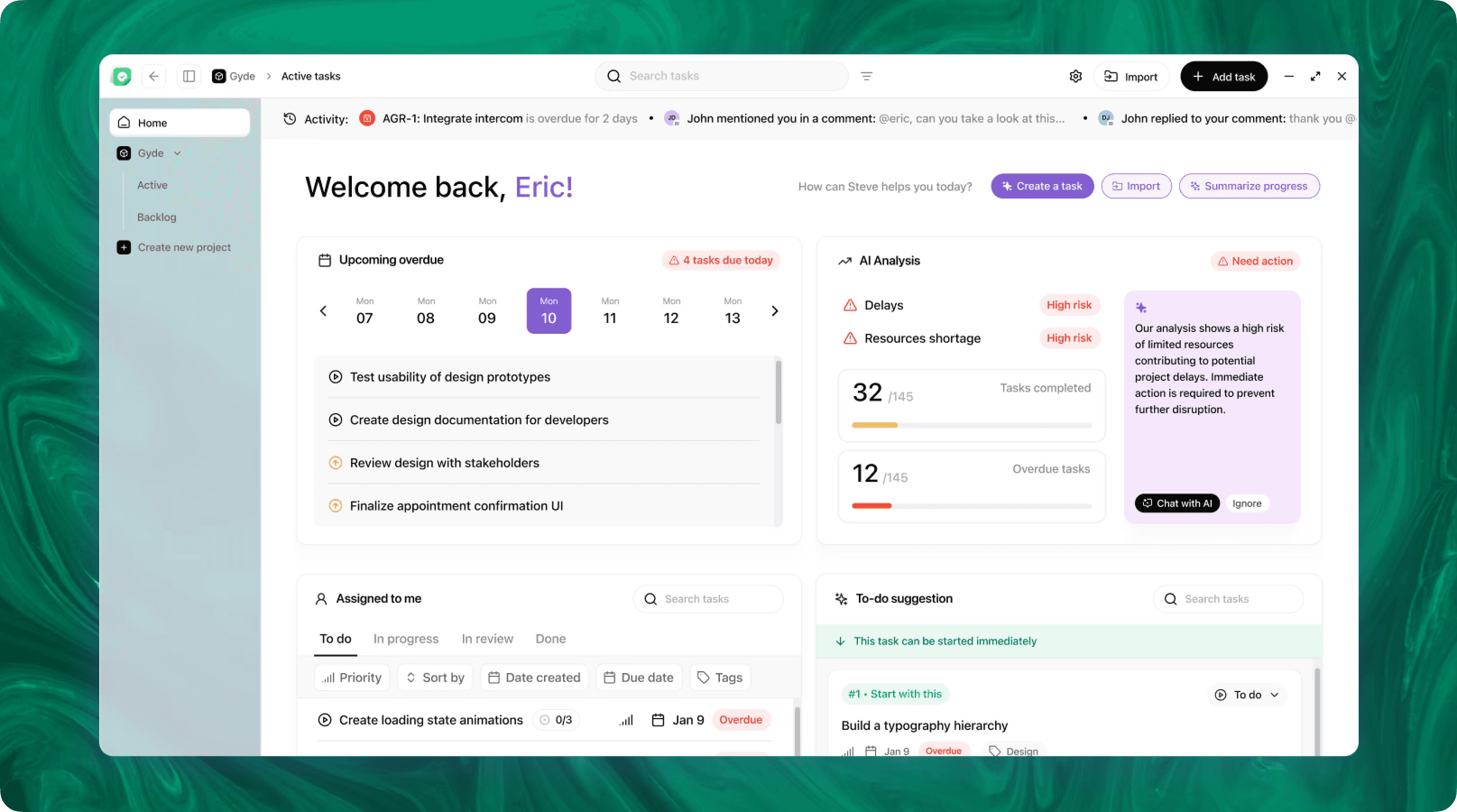
Steve is an AI-native operating system designed to streamline business operations through intelligent automation. Leveraging advanced AI agents, Steve enables users to manage tasks, generate content, and optimize workflows using natural language commands. Its proactive approach anticipates user needs, facilitating seamless collaboration across various domains, including app development, content creation, and social media management.
Conclusion
Steve’s difference lies in composition and continuity. As an AI OS, Steve combines a shared memory backbone, action-capable conversational interfaces, code-generation through Vibe Studio, and AI-driven task orchestration to convert conversation into coordinated work. That architecture reduces repetition, eliminates unnecessary tool switching, and creates reusable artifacts — turning interactions into progress rather than transient answers. For teams seeking an AI that integrates with their tools, preserves institutional context, and delivers production-grade outputs, Steve represents a step beyond traditional assistants toward an operational platform that drives results.