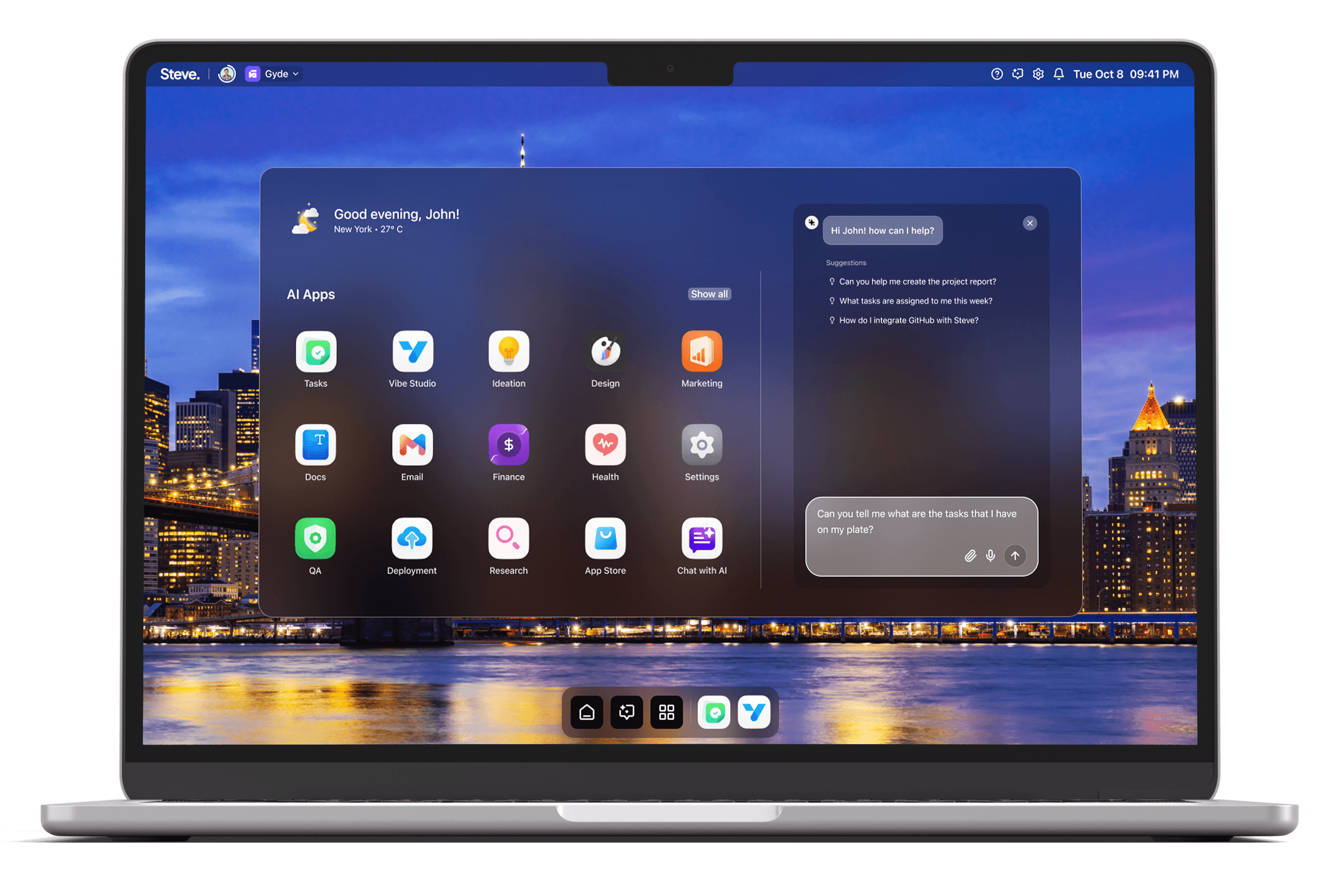
What An AI Operating System Looks Like In Practice
Feb 20, 2026

Conversational Coordination With Steve Chat: Conversation replaces tool-hopping—Steve’s chat coordinates actions across services and incorporates files for context-rich workflows.
Persistent Shared Memory For Continuity: Shared memory preserves decisions and project facts so multi-step workflows maintain intent and reduce repetitive prompting.
Integrated AI Email To Reduce Cognitive Load: An embedded smart inbox with summaries and draft assistance cuts inbox overhead and keeps replies aligned with project context.
Prompt-To-Production Output With Vibe Studio: Vibe Studio turns natural prompts into runnable Flutter code and previews, enabling the AI OS to deliver deployable artifacts.
Introduction
An AI Operating System in practice is less about a single interface and more about a connective layer that lets people and intelligent agents share context, act on information, and complete work without friction. Steve demonstrates what that layer looks like: a conversational hub driven by advanced AI agents, a shared memory that preserves context across interactions, an integrated AI Email workspace that reduces inbox overhead, and a prompt-to-production Vibe Studio that turns intent into runnable apps. Together these elements show how an AI OS coordinates tasks, preserves state, and delivers production outputs.
Conversational Coordination With Steve Chat
At the core of an AI OS is conversation as an operating primitive. Steve’s conversational interface lets users instruct agents in plain language while the system routes commands to integrated services — calendar, drive, repositories, and live web search — so a single chat can schedule meetings, fetch documents, and synthesize answers. Because Steve is file-aware and supports uploads, conversations include direct access to PDFs, spreadsheets, and images, enabling richer, context-sensitive responses.
In practice this changes day-to-day workflows: instead of switching tools to draft an agenda, locate the latest spec, and update a calendar, a product lead can ask Steve in one chat to summarize the spec, extract action items, and propose slots for a kickoff. The AI OS returns a coherent plan and can post the event to calendar integrations, keeping execution tight. This conversational-first model reduces context switching and lets teams treat the AI OS as a persistent collaborator.
Persistent Shared Memory For Continuity
A practical AI Operating System must remember and reason over past interactions. Steve’s shared memory system gives agents a durable context layer: notes, project facts, and prior decisions persist so agents can reference them and collaborate coherently. That shared memory prevents repetitive prompts and lets multi-step workflows span hours or days without losing intent.
Consider a multi-week product rollout: early research, design notes, and stakeholder feedback are captured in Steve’s memory. Later, when an engineer asks for a testing checklist, the AI pulls requirements, compliance notes, and previous testing outcomes from memory to produce a focused plan. The result is uninterrupted institutional knowledge: the AI OS preserves the decision trail and accelerates future reasoning.
Integrated AI Email To Reduce Cognitive Load
An AI OS must also tame the inbox. Steve’s AI Email embeds a smart inbox directly in the platform with real-time sync, AI tags, and thread summarization, so critical conversations surface without tab hopping. Users can chat with the AI inside their inbox to draft replies, refine tone, or generate concise summaries of long threads, all while remaining in the platform’s shared context.
For example, aCustomer Success manager receives a complex escalation spanning multiple messages and attachments. Steve categorizes the thread, summarizes the issues, and drafts a reply aligned with the account’s history stored in shared memory. That draft can be edited conversationally and sent without leaving the AI OS. Integrated email reduces turnaround time and keeps communications aligned with project context.
Prompt-To-Production Output With Vibe Studio
Real-world AI OS value is measured in outputs you can deploy. Vibe Studio is Steve’s module for turning natural prompts into production-ready Flutter apps, with device-specific previews and an embedded developer surface. By translating design intent into clean, scalable code, Vibe Studio demonstrates how an AI OS moves beyond suggestions to deliver runnable artifacts.
A practical scenario: a small team needs a customer onboarding mini-app for a pilot. Instead of drafting wireframes, the PM describes the flow in Steve, and Vibe Studio generates a working Flutter scaffold that can be previewed on mobile and desktop, pushed to GitHub, or downloaded as a full repo. The AI OS thus becomes a delivery channel—converting conversational requirements into code assets that engineers can refine or ship.
Steve
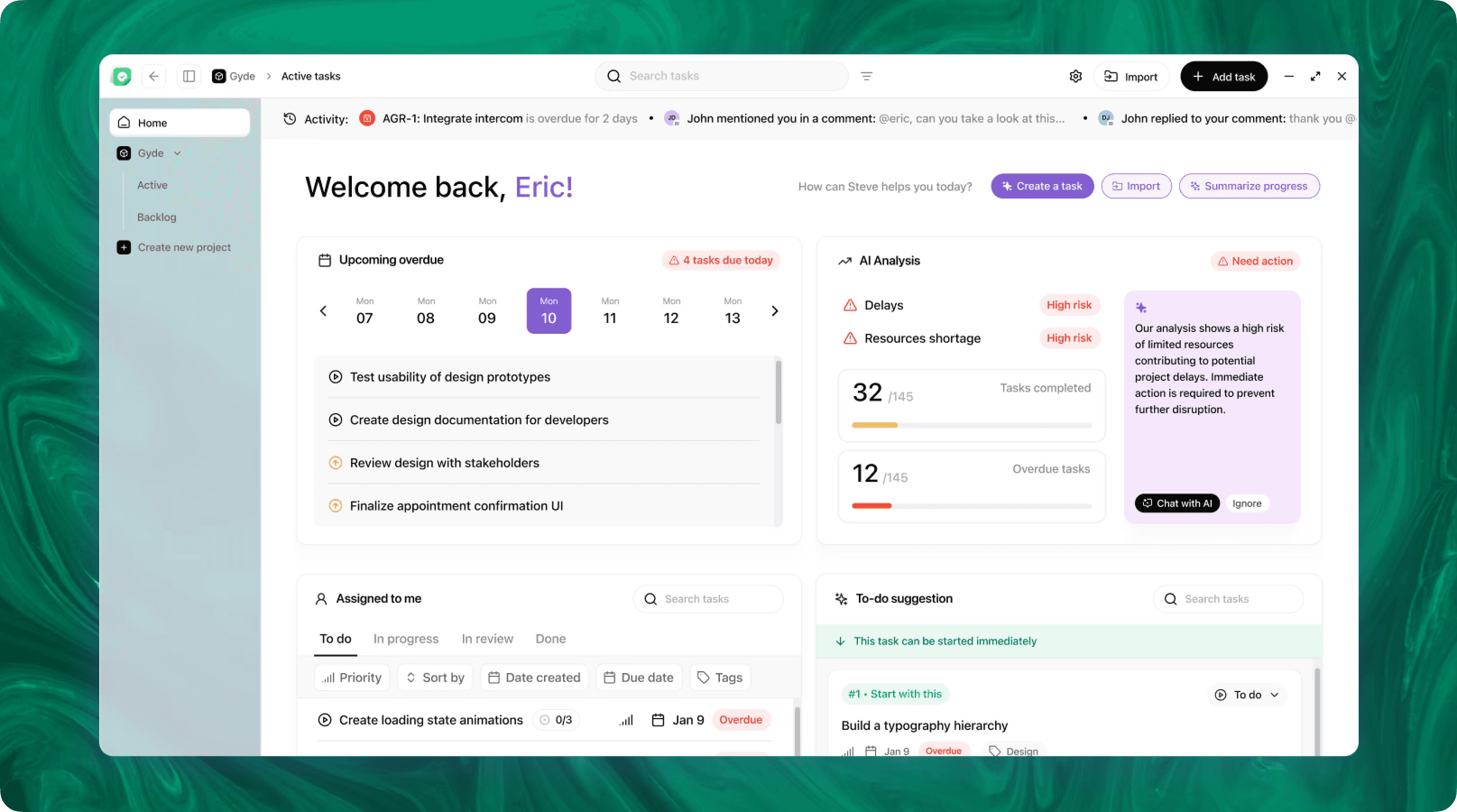
Steve is an AI-native operating system designed to streamline business operations through intelligent automation. Leveraging advanced AI agents, Steve enables users to manage tasks, generate content, and optimize workflows using natural language commands. Its proactive approach anticipates user needs, facilitating seamless collaboration across various domains, including app development, content creation, and social media management.
Conclusion
An AI Operating System in practice blends conversational control, persistent context, integrated communications, and direct artifact generation. Steve embodies this approach: its chat-centric interface coordinates actions across services, shared memory preserves institutional context, AI Email reduces inbox friction, and Vibe Studio converts intent into deployable apps. The practical result is a workspace where direction, data, and deliverables live in a single, intelligent layer — shortening feedback loops, reducing rework, and making automation an everyday, dependable capability.