The Future Of Work Runs On Ai Operating Systems
Oct 7, 2026

Conversational Productivity: Natural-language AI agents connected to calendars and document stores let teams convert multi-step coordination into single conversational actions.
Shared Memory And Agent Collaboration: A persistent shared memory enables agents to carry context across tools, reducing handoffs and repeated explanations.
Smart Email As A Workflow Hub: Integrated AI Email transforms inboxes into actionable hubs with summaries, tags, and in-inbox drafting to accelerate triage and decisions.
AI-Powered Task Management And Execution: AI-driven boards import or generate tasks, propose sprints, and automate status updates to shorten the path from intent to delivery.
Systemic Benefit: An AI OS that combines conversation, memory, email, and task automation reduces context switching and speeds decision cycles across organizations.
Introduction
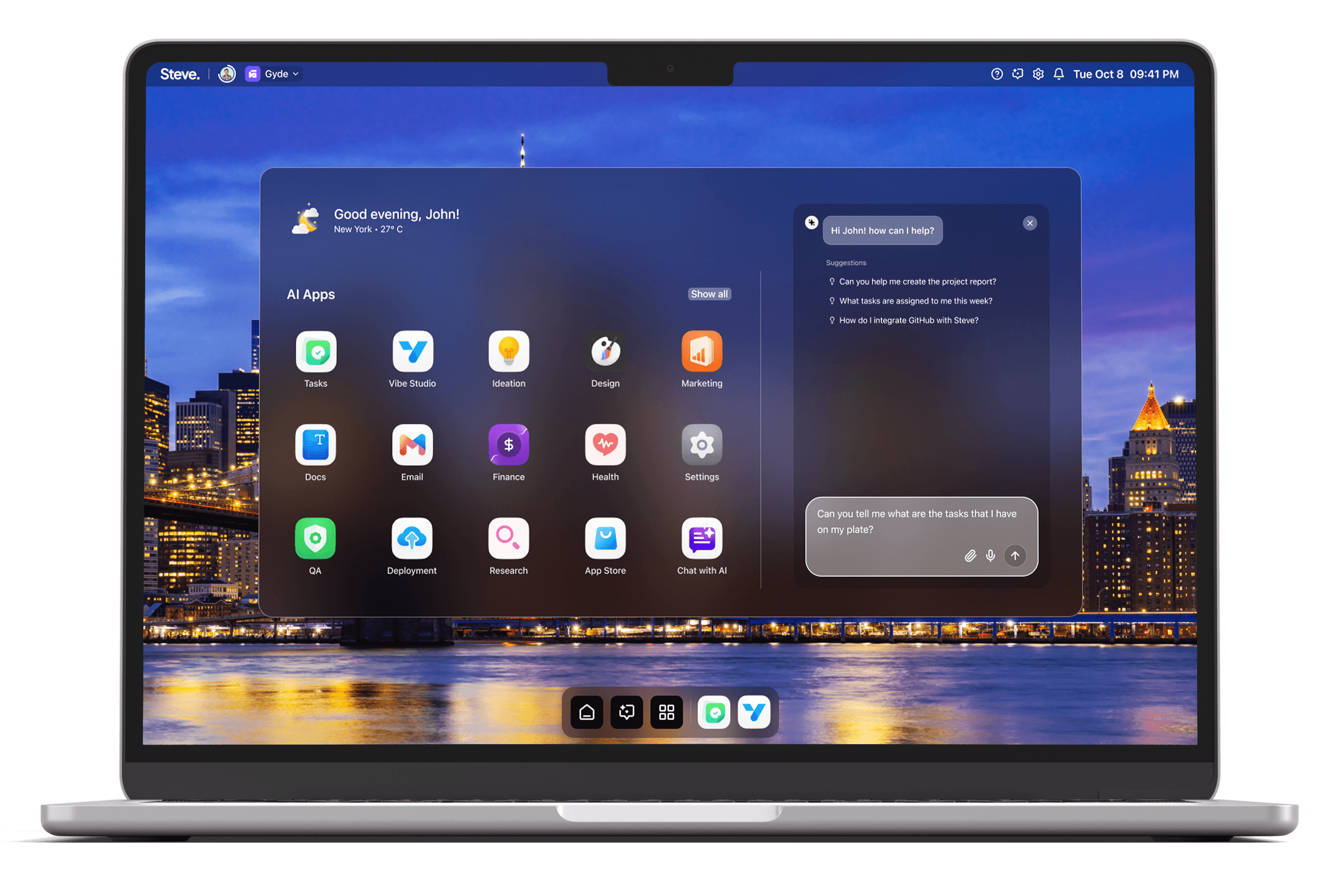
The future of work will be organized around AI Operating Systems that unify tools, data, and decision-making into a single, intelligent workspace. An AI OS shifts work from manual orchestration to proactive orchestration: it routes context, automates routine outputs, and keeps teams aligned. Steve is an AI OS built to streamline operations through conversational AI agents, a shared memory layer, a smart inbox, and AI-driven task management—making distributed teams faster, less error-prone, and more adaptive.
Conversational Productivity
Workflows collapse when conversational interfaces replace menu-driven workflows. Steve’s conversational interface, powered by advanced AI agents and large language models, lets people complete complex work by talking or typing natural requests: schedule meetings, find documents, resolve issues, or generate deliverables. Because Steve Chat connects directly with calendars, email, Drive, Sheets, Notion, GitHub, and 40+ services, a single prompt can surface the right artifacts and execute actions without context switching. In practice, a product lead can ask Steve to “summarize last quarter’s roadmap items that are still open and schedule a planning session with stakeholders,” and the AI agent will pull files, surface key threads, propose times, and create calendar invites—turning multi-step coordination into a single conversational exchange.
Shared Memory And Agent Collaboration
An AI OS becomes transformational when its agents share state and context rather than operating in isolated silos. Steve’s shared memory system lets agents read and write contextual signals, so the outputs of one agent are immediately usable by another. That persistent, contextual memory preserves decisions, constraints, and priorities across sessions and tools—so a hiring-context created in chat becomes the same context used by task automation and email composition. The result is continuity: handoffs are reduced, repeated explanations vanish, and automated agents can collaborate on composite tasks like drafting a proposal, generating supporting data, and updating the project board with a single, coherent provenance trail.
Smart Email As A Workflow Hub
Email remains central to knowledge work; an AI OS must turn it from a time sink into an actionable hub. Steve’s AI Email integrates a smart inbox with real-time sync, AI tags, thread summaries, and context-aware reply suggestions so teams can triage faster and act with confidence. Users can chat with AI inside the inbox to draft and refine responses or extract action items from long threads. Because Steve can generate instant summaries and categorize messages, leaders regain the signal in noisy mailstreams, quickly escalating critical issues and converting conversations into tasks or calendar events without leaving the inbox.
AI-Powered Task Management And Execution
Planning and execution are where strategy meets delivery, and an AI OS should close the loop between intent and output. Steve’s AI-powered product management boards consolidate planning, execution, and updates into one workspace and integrate with tools like Linear to import or create tasks from prompts. The system proposes sprints, suggests prioritization, and applies context-aware automation to update status and surface blockers—reducing manual status updates and keeping stakeholders informed. In a practical scenario, a manager can ask Steve to “create a two-week sprint from these backlog items, assign owners, and notify the team,” and the AI will build the sprint, set deadlines, and create the notification cadence, enabling teams to move from intent to execution in minutes rather than days.
Steve
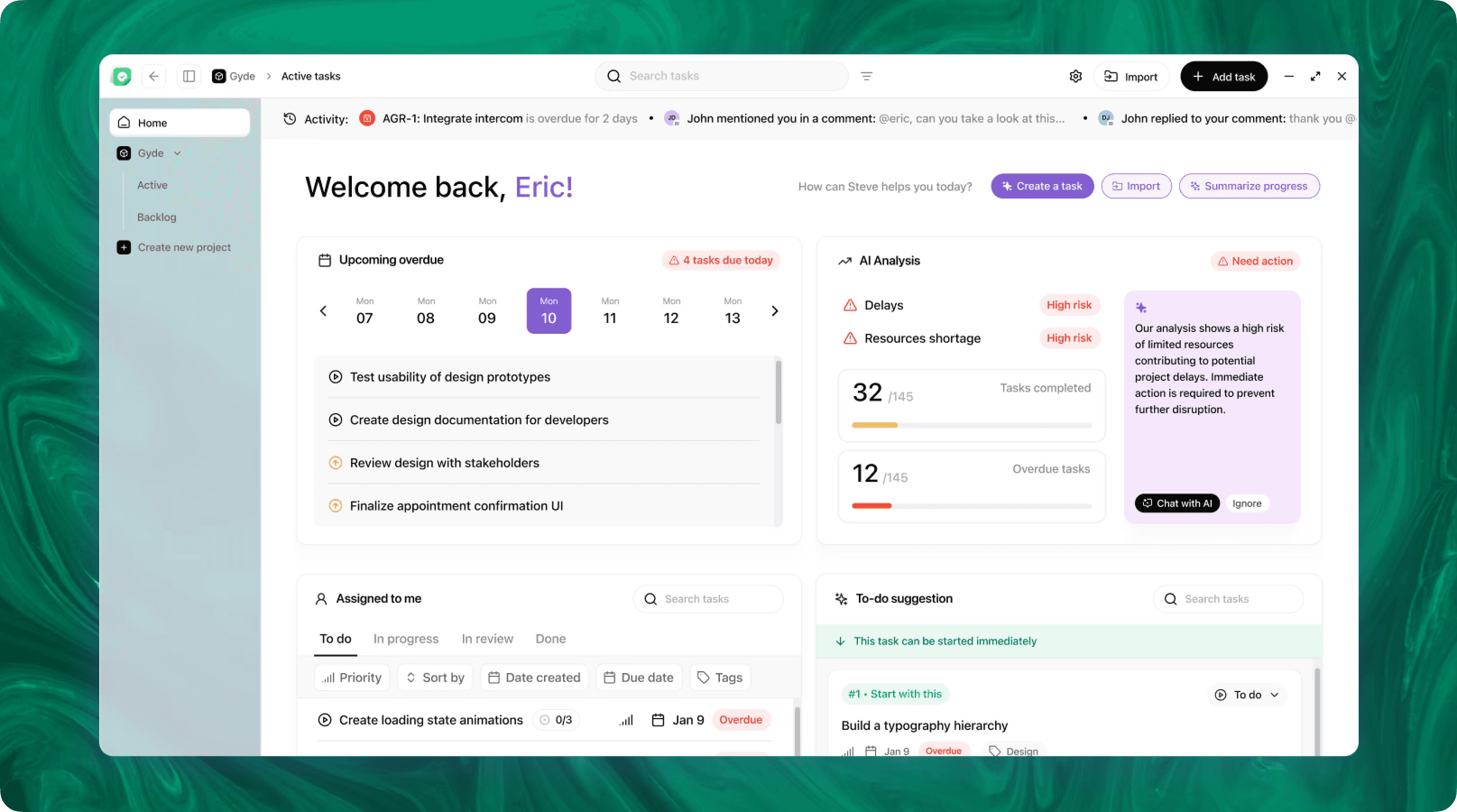
Steve is an AI-native operating system designed to streamline business operations through intelligent automation. Leveraging advanced AI agents, Steve enables users to manage tasks, generate content, and optimize workflows using natural language commands. Its proactive approach anticipates user needs, facilitating seamless collaboration across various domains, including app development, content creation, and social media management.
Conclusion
The future of work runs on AI Operating Systems because they convert fragmented tools into a continuous, context-aware work surface. By combining conversational productivity, a shared memory layer for agent collaboration, an intelligent inbox, and AI-driven task management, Steve delivers that surface: a unified AI OS that reduces context switching, preserves institutional memory, and automates routine coordination. Organizations that adopt Steve can expect faster decision cycles, clearer accountability, and more time for high-value work—precisely the outcomes an AI OS promises for the next era of work.