The Difference Between Automating Tasks And Automating Judgment
Oct 7, 2026

Automating Repetitive Tasks: Use deterministic rules and Steve’s Task Management to reliably replace manual handoffs and template-driven work.
Contextual Judgment Requires Memory: Shared memory enables agents to aggregate history and institutional context before recommending decisions.
Conversational Oversight: Steve Chat turns recommendations into auditable, editable judgments through file-aware, step-by-step explanations.
Safe Automation Patterns: Prefer suggested actions and drafts over automatic execution when uncertainty or risk is present, using task boards for escalation.
Speed Without Abdication: Combining AI Email summaries, task automation, shared memory, and conversational workflows preserves human responsibility while accelerating execution.
Introduction
Automating tasks and automating judgment are adjacent but distinct goals: the former replaces repeatable work; the latter codifies discretionary decision-making. As businesses scale, confusing the two creates brittle automation or wasted human time. Steve, an AI Operating System, is designed to make that distinction practical—accelerating routine work while augmenting human judgment where nuance matters. This article explains how organizations can separate task automation from judgment automation and how Steve’s shared memory, conversational AI, smart inbox, and task-management capabilities enable that balance.
Automating Repetitive Tasks: Predictable, Measurable Work
Task automation succeeds when inputs, expected outputs, and rules are explicit. Examples include routing invoices, tagging emails, syncing calendar invites, or moving an issue across a board when a checklist completes. Steve’s Task Management boards and integrations make these flows visible and enforceable: the system can propose sprints, import tasks from Linear, and keep execution updates centralized so routine transitions happen without manual overhead.
A practical scenario: when a marketing brief reaches “approved” status, Steve’s automation rules can create related tasks, assign owners, and populate templates—reducing handoffs and ensuring consistency. Similarly, Steve’s AI Email tags and summarizes threads to surface actionable items; that reduces the manual triage that typically consumes knowledge workers’ time. Automating these deterministic steps yields reliable throughput improvements and lower operational cost.
Automating Judgment: Context, Memory, and Responsible Delegation
Judgment requires context, history, and the ability to defer when uncertainty is high. This is where automating judgment differs: it requires ongoing context aggregation and the capacity to explain or escalate decisions. Steve’s shared memory system lets AI agents interact and retain context across conversations and tasks, so decisions carry institutional knowledge rather than being one-off outputs.
For instance, routing a customer escalation shouldn’t be a blind rule based solely on keywords. With shared memory, Steve can surface prior interactions, contractual terms, and recent product incidents before recommending an owner or a response. That contextual grounding lets the system produce recommendations rather than irrevocable actions—automating the judgment-support step while leaving final authority to a human.
Conversational Interfaces: From Static Rules To Interactive Judgment Support
A conversational AI turns recommendations into usable judgment by letting people interrogate reasoning and adjust constraints. Steve Chat provides a file-aware, integrative conversational surface where users can query documents, pull calendar context, and get step-by-step explanations of the AI’s reasoning. This makes automated judgment auditable and revisable.
In practice, a product manager can ask Steve to prioritize bug fixes for the next sprint; Steve Chat can list relevant customer reports, link to the issue board, and present a recommended ranking with supporting context. The manager can accept, modify, or reject the recommendation in conversation. That loop—recommendation, explanation, human edit—defines safe automation of judgment: the system speeds decisions while preserving human oversight.
Designing Escalation Paths And Trust Boundaries
Automation that encroaches on judgment must include explicit escalation and reversible actions. Steve’s Task Management and AI Email features provide the scaffolding: automated tagging and summary generation highlight candidates for automated action, while task boards show ownership and status without masking provenance. When confidence is low or the cost of error is high, Steve can surface a suggested next step instead of taking action, or create a task that routes to a human reviewer.
A concrete example: AI Email might summarize a long contract negotiation thread and suggest draft replies; instead of sending automatically, Steve creates a draft and a task assigned to legal with the summary attached. That preserves speed—drafting time is saved—while keeping judgment squarely with the appropriate role.
Steve
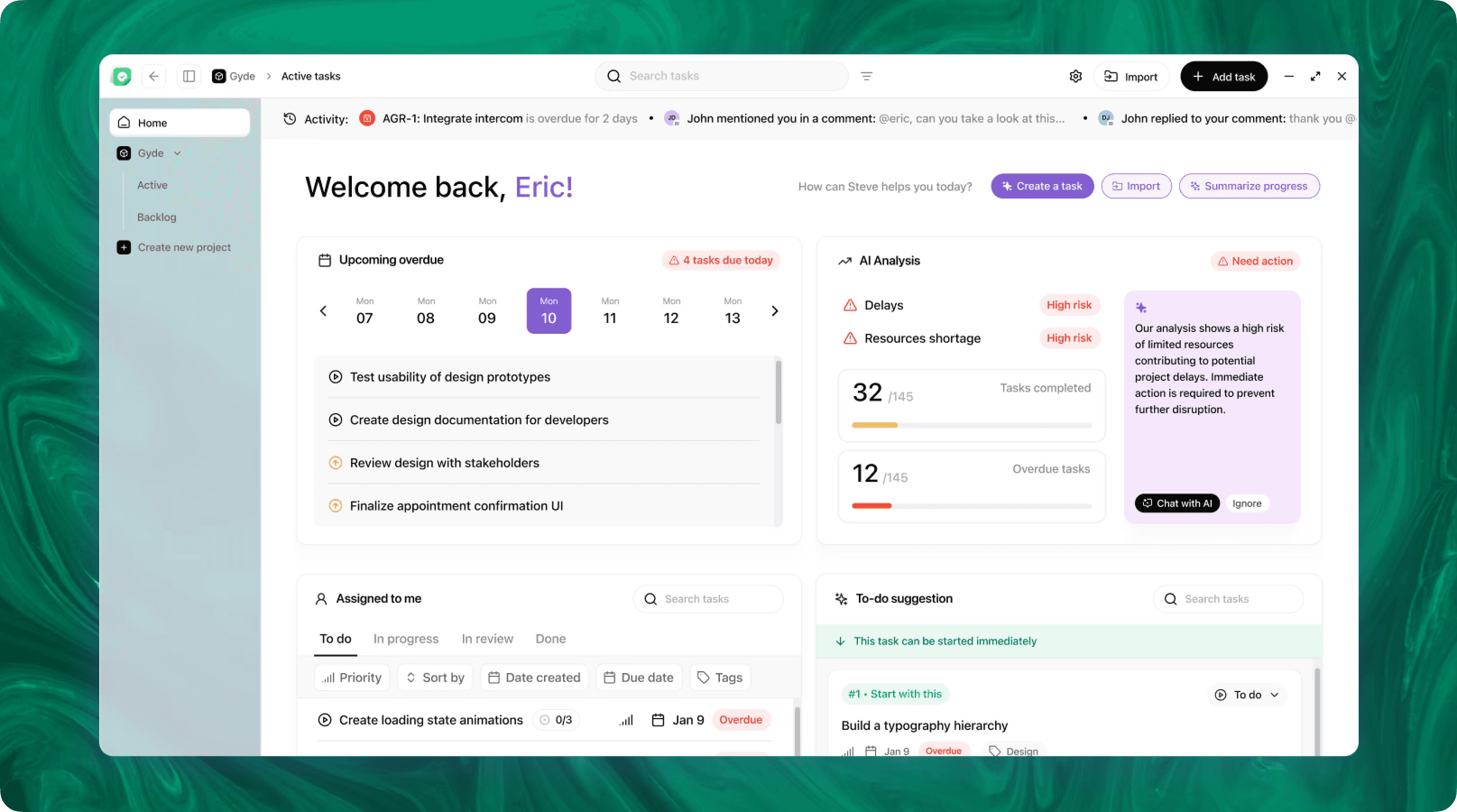
Steve is an AI-native operating system designed to streamline business operations through intelligent automation. Leveraging advanced AI agents, Steve enables users to manage tasks, generate content, and optimize workflows using natural language commands. Its proactive approach anticipates user needs, facilitating seamless collaboration across various domains, including app development, content creation, and social media management.
Conclusion
The operational difference between automating tasks and automating judgment is one of certainty and context: task automation replaces deterministic work, while judgment automation augments decision-making with context-rich recommendations and clear escalation paths. As an AI OS, Steve combines shared memory, conversational AI, a smart inbox, and task-management boards to accelerate routine work and to surface informed recommendations where human discretion matters. The result is faster execution without surrendering responsibility—automation that scales reliably because it knows when to act and when to ask.