Steve for Subscription Businesses: Churn Monitoring and Insights
Jan 22, 2026

Persistent Customer Context With Shared Memory: A unified memory lets AI agents link billing, support, and behavior over time so emerging churn patterns surface reliably.
Email Signal Extraction and Rapid Triage: AI Email tags, summarizes, and drafts context‑aware replies to elevate true cancellation or dispute risks for fast action.
Cross‑Source Analysis Through Conversational Investigation: Steve Chat pulls data from Sheets, Drive, and connected services so teams can query and correlate signals in natural language.
Operationalizing Insights With AI‑Driven Task Management: Task boards and Linear integration convert churn insights into prioritized sprints, tickets, and measurable remediation work.
Workflow Benefit: Combining memory, inbox intelligence, conversational analysis, and task automation closes the loop from detection to execution, improving retention outcomes.
Introduction
Subscription businesses live or die by retention. Monitoring churn requires continuous signal collection, rapid synthesis, and coordinated action across sales, support, and product teams. Steve, an AI Operating System, combines persistent memory, in‑inbox intelligence, conversational analysis, and AI task management to surface churn signals, translate them into prioritized interventions, and keep teams aligned. This article outlines practical ways Steve turns dispersed data into timely churn monitoring and actionable insights.
Persistent Customer Context With Shared Memory
Longitudinal customer context is essential to spot early signs of churn: billing hiccups, repeated support interactions, or a drop in feature usage only register as a pattern when stitched together. Steve’s shared memory enables AI agents to retain and recall multi‑session context about accounts, so every interaction enriches a single, evolving customer profile. In practice, when a customer escalates an issue after two recent payment failures, Steve links those events with past NPS notes and trial activity to surface a risk score and suggested outreach language.
This shared memory reduces repetition across teams: support sees prior negotiation attempts, sales sees prior concessions, and product sees feature adoption history — all from one conversational interface. That continuity speeds triage and prevents the fragmentation that lets churn slip through the cracks.
Email Signal Extraction and Rapid Triage
A large portion of churn signals travels by email: cancellation notices, billing disputes, or frustrated feature requests. Steve’s AI Email parses inbox traffic, applies AI tags and categories, and generates concise summaries of long threads so teams can prioritize true retention risks instead of triaging every ticket. For example, Steve can auto‑tag threads mentioning "cancel," "refund," or repeated access issues, summarize the thread into key facts (dates of failed payments, promised fixes, sentiment), and propose a reply tailored to the account’s history.
That process shortens response time and elevates the right conversations. Customer success teams get a prioritized queue of high‑risk accounts with summary context and context‑aware reply drafts, enabling faster, more consistent retention outreach that reflects the customer’s full history.
Cross‑Source Analysis Through Conversational Investigation
Churn analysis requires correlating billing records, usage logs, support tickets, and contract notes — often scattered across Sheets, Drive, CRMs, and shared documents. Steve Chat’s integrations and file‑aware capabilities let teams query that cross‑system data in natural language and receive integrated answers. Ask Steve: "Show accounts with two or more failed payments and declining active days over the last 30 days," and it returns a consolidated list with hyperlinks to supporting documents, recent thread summaries, and risk indicators.
Beyond static reports, conversational investigation supports what‑if exploration: stakeholders can ask follow‑ups, request sample outreach templates, or ask Steve to draft a one‑page executive memo summarizing root causes. Real‑time web lookups enrich context where external factors matter (competitor pricing changes, industry news), while file uploads let teams attach logs or invoices for richer analysis without switching tools.
Operationalizing Insights With AI‑Driven Task Management
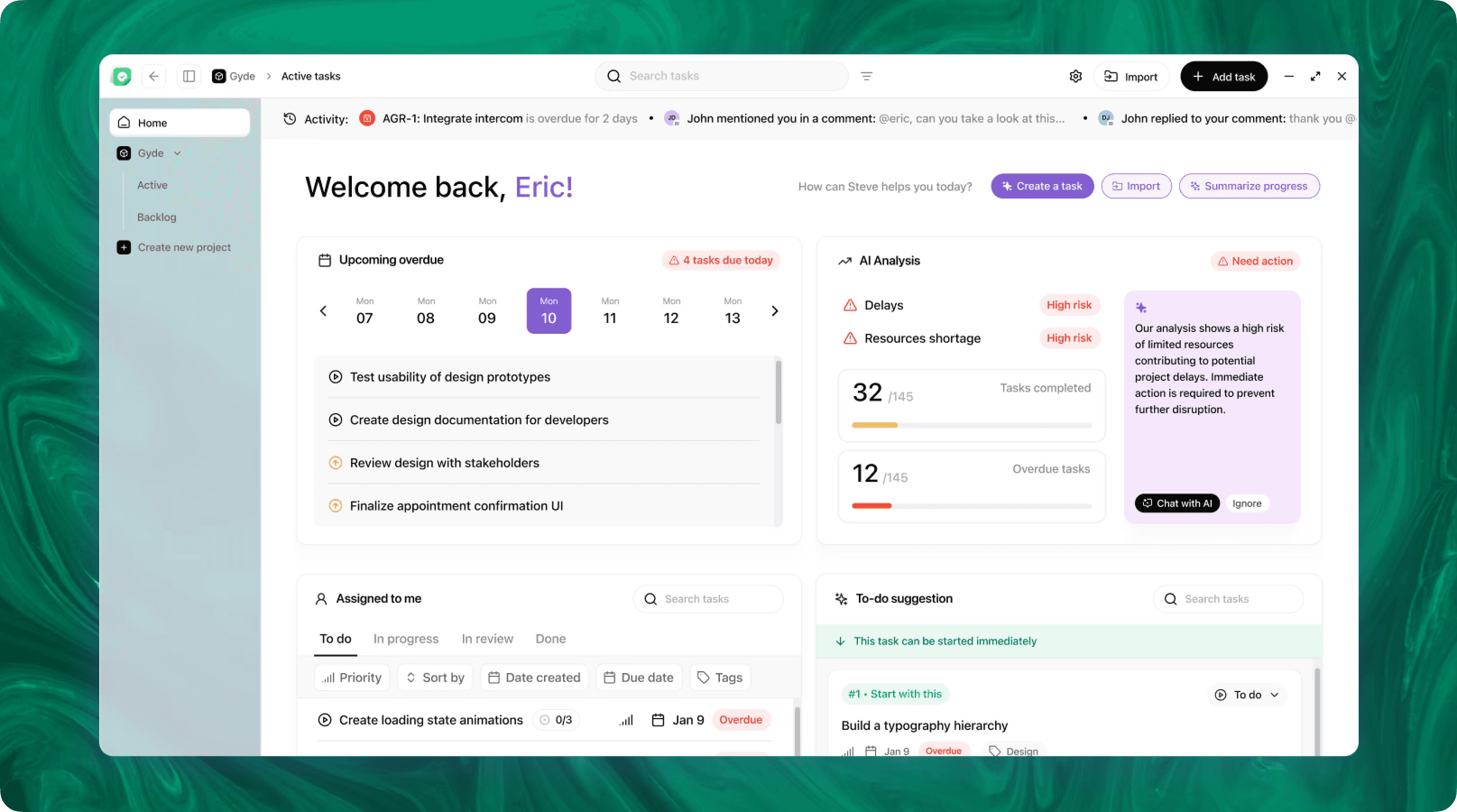
Insights matter only when they lead to coordinated work. Steve’s Task Management translates churn signals into concrete tasks, creates product or CX boards, and helps prioritize engineering and outreach work. When Steve identifies a cohort experiencing onboarding friction, it can propose a sprint of targeted fixes, generate user stories, and sync tasks into Linear or your project board for execution.
A practical workflow: Steve flags a segment of high‑value customers at risk, drafts personalized outreach templates for CX, creates remediation tickets for product engineers with linked evidence, and suggests a two‑week sprint with measurable goals. Teams keep progress in one workspace, and Steve’s memory preserves context so follow‑up conversations and outcomes remain connected to the original insight.
Steve
Steve is an AI-native operating system designed to streamline business operations through intelligent automation. Leveraging advanced AI agents, Steve enables users to manage tasks, generate content, and optimize workflows using natural language commands. Its proactive approach anticipates user needs, facilitating seamless collaboration across various domains, including app development, content creation, and social media management.
Conclusion
Churn monitoring for subscription businesses is a continuous loop of detection, analysis, and action. As an AI OS, Steve accelerates that loop by maintaining persistent customer context, extracting and summarizing email signals, enabling cross‑source conversational analysis, and converting insights into prioritized tasks. The result is faster identification of at‑risk customers, more relevant outreach, and tighter coordination between CX, product, and growth — all driven from a single conversational surface that keeps context alive and actionable.