Steve for Finance Leaders: Conversational Cash Flow Insights
Jan 13, 2026

Conversational Cash Flow Analysis: File-aware chat and Sheets integration let finance leaders query forecasts and generate traceable cash projections without manual exports.
Persistent Context And Shared Memory: Memory preserves assumptions and corrections so follow-up queries and cross-team conversations remain consistent over time.
Email-Driven Synthesis For Stakeholders: AI Email summarizes threads, tags priorities, and drafts context-aware responses to accelerate negotiation and stakeholder communication.
Actionable Workflows And Task Management: Integrated task boards convert conversational insights into assigned, trackable work that links back to the original data and chat.
Workflow Benefit: Combining chat, memory, email synthesis, and tasks reduces decision latency and keeps audit trails intact from insight to execution.
Introduction
Cash flow sits at the center of strategic finance: forecasting runway, prioritizing vendor payments, and signaling when to tighten or accelerate spend. For finance leaders who need fast, defensible answers without losing context across sources, Steve provides a conversational bridge between raw data and actionable decisions. As an AI Operating System, Steve combines a chat-first interface, file-aware analysis, persistent memory, and integrated tasking to surface cash flow insights conversationally and convert them into managed workstreams.
Conversational Cash Flow Analysis
Finance leaders can upload spreadsheets, point Steve at live Google Sheets, or attach bank statements and ask precise questions in plain language. Steve’s chat interface is file-aware and integrates with Google Drive and Sheets, so the AI can read line items, map categories, and compute rolling cash positions without manual exports. Instead of wrestling with pivot tables, a CFO can ask: “Show me projected cash balance for the next 90 days under current burn and a 15% revenue dip,” and receive a traceable table and rationale the team can review.
A practical scenario: during a fundraising cadence, the finance lead uploads the latest forecast and asks Steve to identify the three largest timing risks to runway. Steve returns prioritized risks with the supporting rows, highlights assumptions driving the exposure, and lists the cells or files it used—letting the finance team validate and act quickly. This reduces latency between data refresh and decision.
Persistent Context and Shared Memory
Steve’s shared memory system preserves context across conversations and agents so cash-flow analysis survives follow-ups, new uploads, and cross-team interactions. When a controller corrects an expense classification, that update can persist in memory and inform subsequent queries; when the head of sales asks about promotional spend impact, Steve can reference the same corrected dataset without re-ingestion.
In practice, this means ongoing threads maintain lineage: a monthly cash review stored in Steve’s memory becomes the canonical conversational thread for future “what-if” modeling. Finance leaders gain continuity—assumptions, reconciliations, and prior recommendations remain accessible, reducing repeated work and ensuring consistency across forecasts.
Email-Driven Synthesis For Stakeholders
Cash decisions are often triggered by email threads—vendor notices, lender covenants, or customer payment disputes. Steve’s AI Email integrates a smart inbox with real-time sync and generates concise summaries of lengthy threads, tags urgent items, and drafts context-aware replies. Finance leaders can ask Steve to “summarize the vendor dispute chain and suggest three negotiation levers,” then forward the draft response or refine it conversationally inside the same interface.
A practical use case: after receiving mixed timeline commitments from a major supplier, a finance director uses Steve to synthesize the thread into a one-page memo, attach the relevant forecast lines, and create a proposed payment schedule. That memo becomes the starting point for negotiation and the basis for task assignments in Steve’s task boards.
Actionable Workflows and Task Management
Insights without execution stall. Steve’s task management converts conversational outputs into tracked work: create vendor negotiation tasks, schedule follow-up reminders, or propose a sprint to reduce discretionary spend. The system integrates with tools like Linear and supports AI-suggested sprints so finance leaders can move from insight to accountable action without context loss.
For example, after identifying a cash shortfall scenario, Steve can generate a task board with owner assignments, due dates, and suggested next steps—collect AP aging, negotiate extended terms, and accelerate collections. Each task links back to the original chat, files, and email summaries so the team retains the thread of evidence that produced the action.
Steve
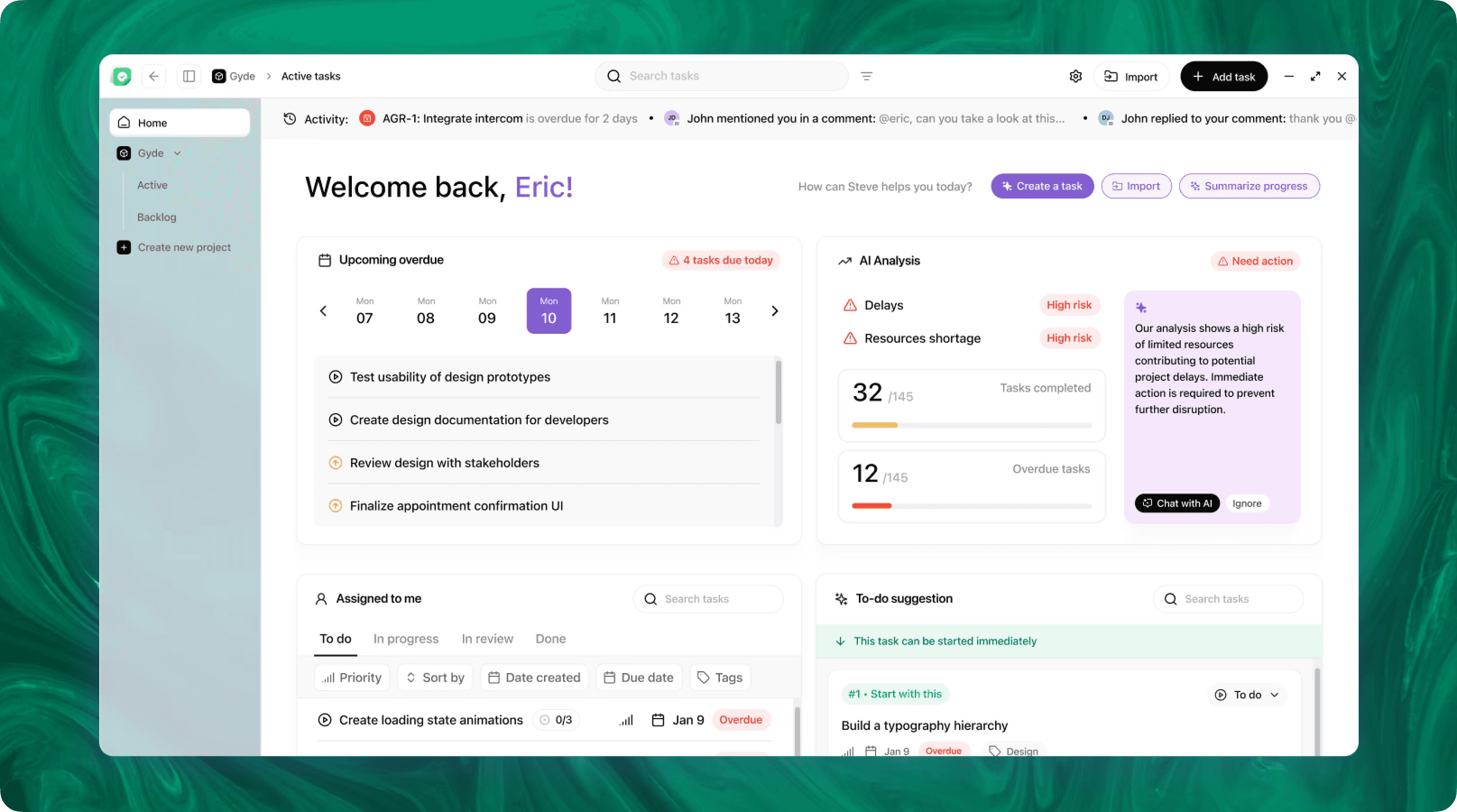
Steve is an AI-native operating system designed to streamline business operations through intelligent automation. Leveraging advanced AI agents, Steve enables users to manage tasks, generate content, and optimize workflows using natural language commands. Its proactive approach anticipates user needs, facilitating seamless collaboration across various domains, including app development, content creation, and social media management.
Conclusion
Steve bundles conversational analysis, shared memory, email synthesis, and task orchestration into a single AI OS that shortens the loop from data to decision. For finance leaders, that means faster, auditable cash-flow answers and a direct path to execution: ask questions in natural language, validate sources, and turn recommendations into tracked work without switching tools. As an AI Operating System, Steve reduces friction between insight and impact, letting finance teams protect runway and make confident, timely choices.