How Steve Supports Decision Journals And Rationale Tracking
Nov 12, 2026

Memory-Centered Contextual Continuity: Shared memory and chat memory preserve the context and source artifacts that make decision journals reliable.
Conversational Decision Capture And Audit Logs: Steve Chat plus LangFuse logging records the reasoning flow and participant inputs for auditable journal entries.
Document-Aware Email Summaries As Evidence: AI Email summarizes long threads and surfaces approval evidence that can be attached to decision records.
Task Boards And Actionable Traceability: Task management integrates decisions into tracked work, linking journal entries to sprints and tickets.
Operational Benefit: Combined, these features reduce reconstruction effort, improve onboarding, and provide an auditable trail from debate to delivery.
Introduction
Decision journals and rationale tracking turn isolated choices into auditable, learnable assets. Steve, an AI Operating System, makes that practical by capturing context, surfacing evidence, and connecting decisions to execution in everyday workflows. This article explains how Steve’s conversational memory, file-aware chat, email summarization, chat logging, and task boards reduce friction for decision journals and keep rationale accessible across teams.
Memory-Centered Contextual Continuity
A decision journal is only useful when it preserves context. Steve’s shared memory and Steve Chat memory provide persistent context that follows conversations and agents across sessions. That memory links prior discussions, uploaded files, and calendar events, so a decision entry can include the exact prompts, constraints, and reference documents that shaped it. In practice, a product lead can ask Steve to recall the prior three options discussed for a roadmap item; Steve replays the relevant excerpts and attached design files so the journal entry reflects the original trade-offs rather than a later reconstruction.
Because Steve is an AI OS with integrations across Google Drive, Notion, and other services, stored context can include the source artifacts that justified choices. This continuity reduces retrospective guesswork: teams see the decision timeline and the evidence that informed it, enabling better postmortems and faster onboarding of new contributors.
Conversational Decision Capture And Audit Logs
Capturing rationale in natural language prevents friction during meetings. Steve Chat supports conversational capture with thoughtful step-by-step reasoning and the ability to attach files and references inline. Participants can record decisions directly in chat, ask Steve to summarize the final rationale, and save that summary as a journal entry. LangFuse integration provides detailed chat logging for optimization and analytics, creating an audit trail of the conversation and the AI’s outputs.
A practical scenario: during a cross-functional review, stakeholders debate two monetization models. A team member requests a Steve summary, which aggregates the arguments, lists the pros and cons, timestamps the conclusion, and stores the transcript. That record becomes the authoritative decision journal entry, complete with the chain of reasoning and who contributed each point—useful for future reviews or compliance checks.
Document-Aware Email Summaries As Evidence
Decision journals often rely on dispersed threads and attachments. Steve’s AI Email collapses long conversations into concise summaries and tags important messages, making negotiation histories and approvals easy to reference. When an email thread contains final approval or a stakeholder caveat, Steve generates an extract that can be appended to a decision journal entry, preserving the negotiation as evidence.
For example, an extended negotiation with a vendor can be summarized and attached to the journal entry so procurement and legal teams immediately see the terms that influenced the decision. This reduces manual chasing for attachments and ensures that the journal stores both the rationale and the primary evidence that underpinned it.
Task Boards And Actionable Traceability
Rationale is most valuable when it ties directly to execution. Steve’s AI-powered task management boards integrate with tools like Linear and propose sprints, letting teams convert decisions into tracked work with context linked to the originating journal entry. When a decision creates new tasks, Steve can attach the journal summary and source artifacts to those tasks so engineers and PMs inherit the why along with the what.
A common use case: a roadmap decision spawns a sprint; Steve creates the sprint, proposes tickets, and links each ticket back to the decision journal entry and the supporting emails or files. During execution, updates live on the same board, preserving the trace from rationale to implementation and making it straightforward to audit changes or revisit assumptions if outcomes diverge.
Steve
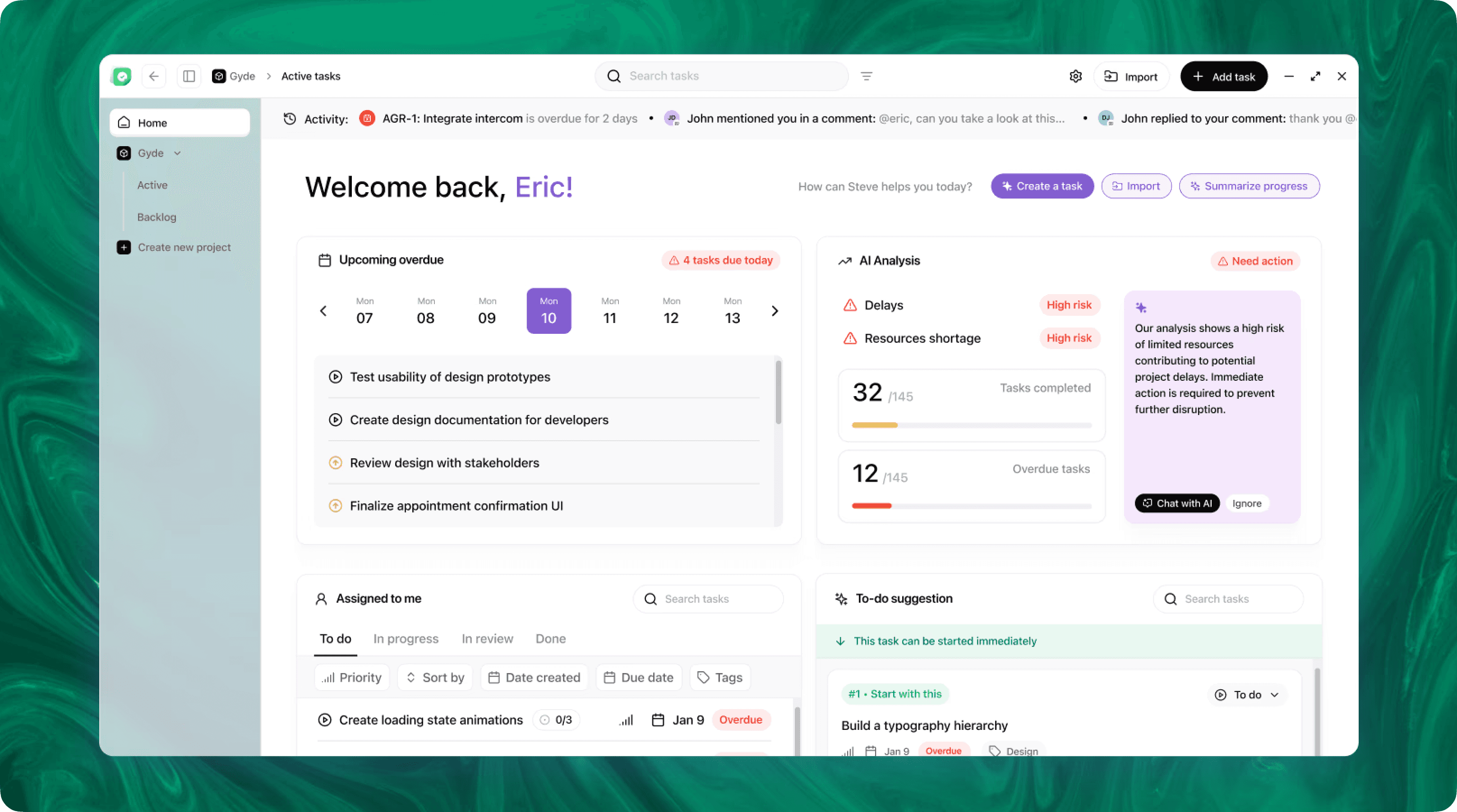
Steve is an AI-native operating system designed to streamline business operations through intelligent automation. Leveraging advanced AI agents, Steve enables users to manage tasks, generate content, and optimize workflows using natural language commands. Its proactive approach anticipates user needs, facilitating seamless collaboration across various domains, including app development, content creation, and social media management.
Conclusion
Steve makes decision journals practical by removing the tedious parts of capture, evidence gathering, and traceability. As an AI Operating System, Steve keeps context in shared memory, captures conversational rationale via Steve Chat with detailed logging, distills supporting threads through AI Email, and ties decisions to execution on task boards. The result: faster, more reliable decision records that help teams learn, comply, and act with clarity across the lifecycle of a choice.