How Steve Makes Institutional Knowledge Actionable
Oct 11, 2026

Persistent Shared Memory: A shared memory preserves rationale and historical context so past decisions are searchable and re-usable.
Conversational Retrieval Through Steve Chat: Natural-language chat with file awareness and integrations surfaces the right artifacts when teams need them.
Inbox-Aware Summaries: AI Email distills long threads, tags priorities, and converts email commitments into clear action items.
AI-Powered Task Management: Integrated task boards translate discovered knowledge into assigned, trackable work and suggested sprints.
Operational Impact: Combining memory, chat, email, and task automation shortens decision cycles and prevents rework.
Introduction
Institutional knowledge — the accumulated decisions, context, and informal rules that live inside teams — is valuable only when it can be retrieved and acted on. Steve makes institutional knowledge actionable by surfacing context, connecting it to work, and turning it into executable next steps. As an AI Operating System, Steve combines persistent shared memory, conversational retrieval, inbox-aware summarization, and task automation to close the gap between what teams know and what they do.
Persistent Shared Memory That Preserves Context
A persistent shared memory lets Steve capture and stitch together conversations, documents, and decisions so context survives personnel changes and fragmented threads. Instead of asking teammates to re-explain why a decision was made, users query Steve and receive answers grounded in recorded rationale: meeting notes, past chats, and uploaded artifacts. This continuity matters because institutional knowledge is often tacit; by making it explicit and searchable, Steve converts vague recollections into precise context that feeds downstream actions.
Practical scenario: a product owner needs the justification for a deprecated feature. Rather than hunting email threads, they ask Steve; the response aggregates the original implementation notes, risk assessments, and the subsequent bug reports that led to the decision, saving hours and preventing redundant work.
Conversational Retrieval Through Steve Chat
Steve Chat exposes institutional knowledge through a conversational interface that remembers prior interactions and connects to calendars, drive files, code repositories, and other systems. Teams interact with Steve in natural language to locate policies, find relevant documents, or get step-by-step guidance tied to current projects. Because the chat is file-aware and integrates with the tools teams already use, responses are grounded in the most current artifacts rather than a static knowledge dump.
In practice, an engineer diagnosing a deployment failure can upload logs, link the incident ticket, and ask Steve for likely root causes and remediation steps. Steve Chat synthesizes the uploaded files with historical incidents and runbooks, turning scattered evidence into a prioritized list of actions.
Inbox-Aware Summaries and Contextual Email Workflows
Email frequently contains critical institutional signals — approvals, constraints, and client commitments — but long threads are time-consuming to parse. Steve’s AI Email features tag and categorize messages, generate concise summaries of lengthy conversations, and draft context-aware replies directly inside the inbox. Those capabilities compress the time to understand commitments and convert email context into tasks or decisions.
A customer success manager, for example, can ask Steve to summarize a month-long negotiation thread and extract open action items and deadlines. Steve’s summary becomes the basis for follow-up tasks and calendar entries, ensuring promises made over email are tracked and executed rather than lost.
Operationalizing Knowledge With AI-Powered Task Management
Knowledge is actionable when it translates into tracked work. Steve’s task management ties insights from shared memory, chat, and email into AI-powered product boards and sprints. The system proposes tasks, sequences work, and surfaces dependencies based on the context it holds, so institutional knowledge directly informs execution plans instead of remaining inert reference material.
Consider a compliance update: Steve identifies affected docs from drive and email approvals, generates a checklist of required changes, and creates tasks assigned to the appropriate owners with suggested deadlines. By closing the loop — from discovery to task creation to progress tracking — Steve converts knowledge into measurable outcomes.
Steve
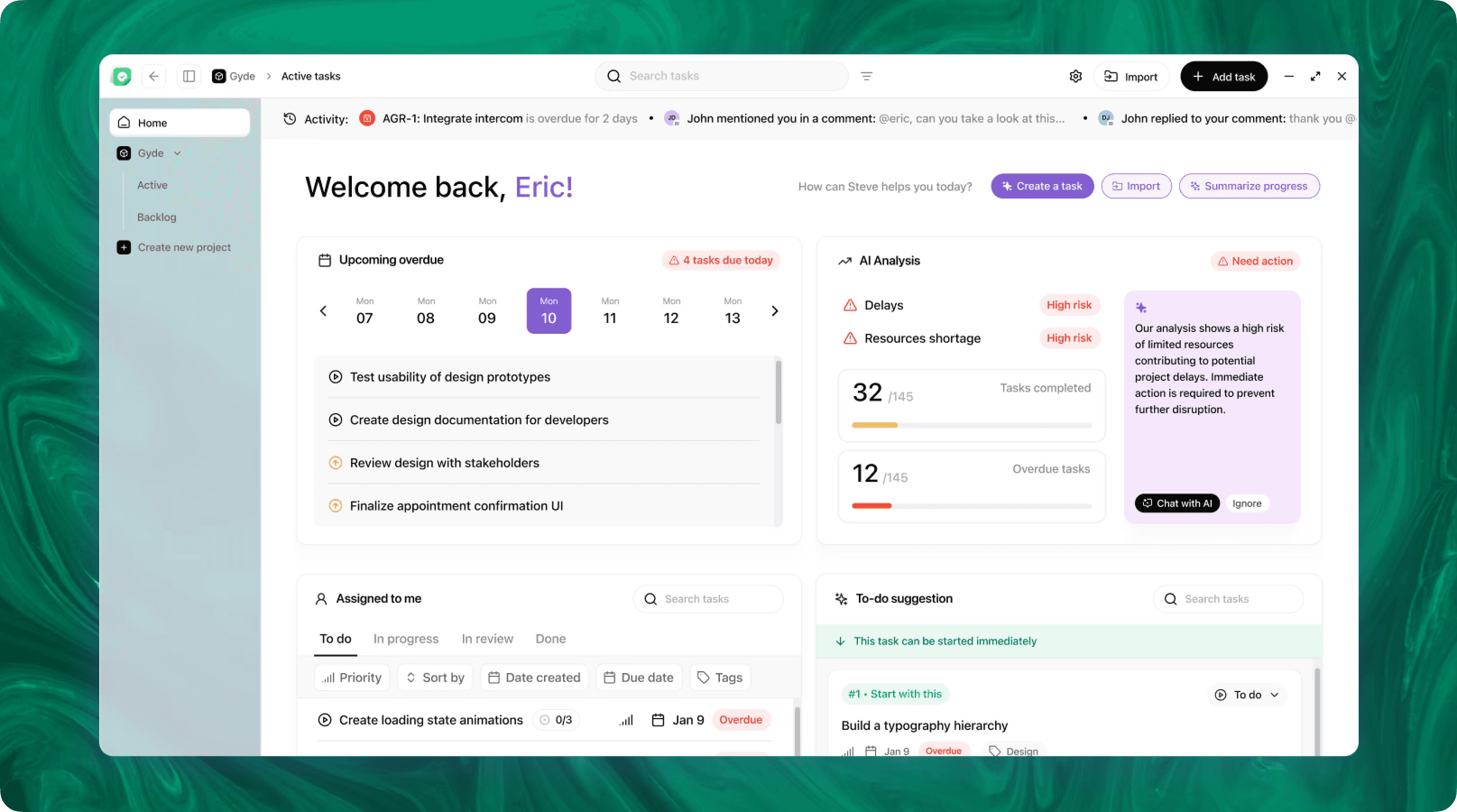
Steve is an AI-native operating system designed to streamline business operations through intelligent automation. Leveraging advanced AI agents, Steve enables users to manage tasks, generate content, and optimize workflows using natural language commands. Its proactive approach anticipates user needs, facilitating seamless collaboration across various domains, including app development, content creation, and social media management.
Conclusion
Making institutional knowledge actionable requires persistent context, intuitive retrieval, inbox-aware distillation, and mechanisms that convert insights into tracked work. Steve, as an AI OS, combines a shared memory system, conversational Steve Chat, AI Email summarization and tagging, and AI-driven task management to do precisely that. The result is faster decision-making, fewer repeated inquiries, and a clear pipeline from organizational memory to execution.