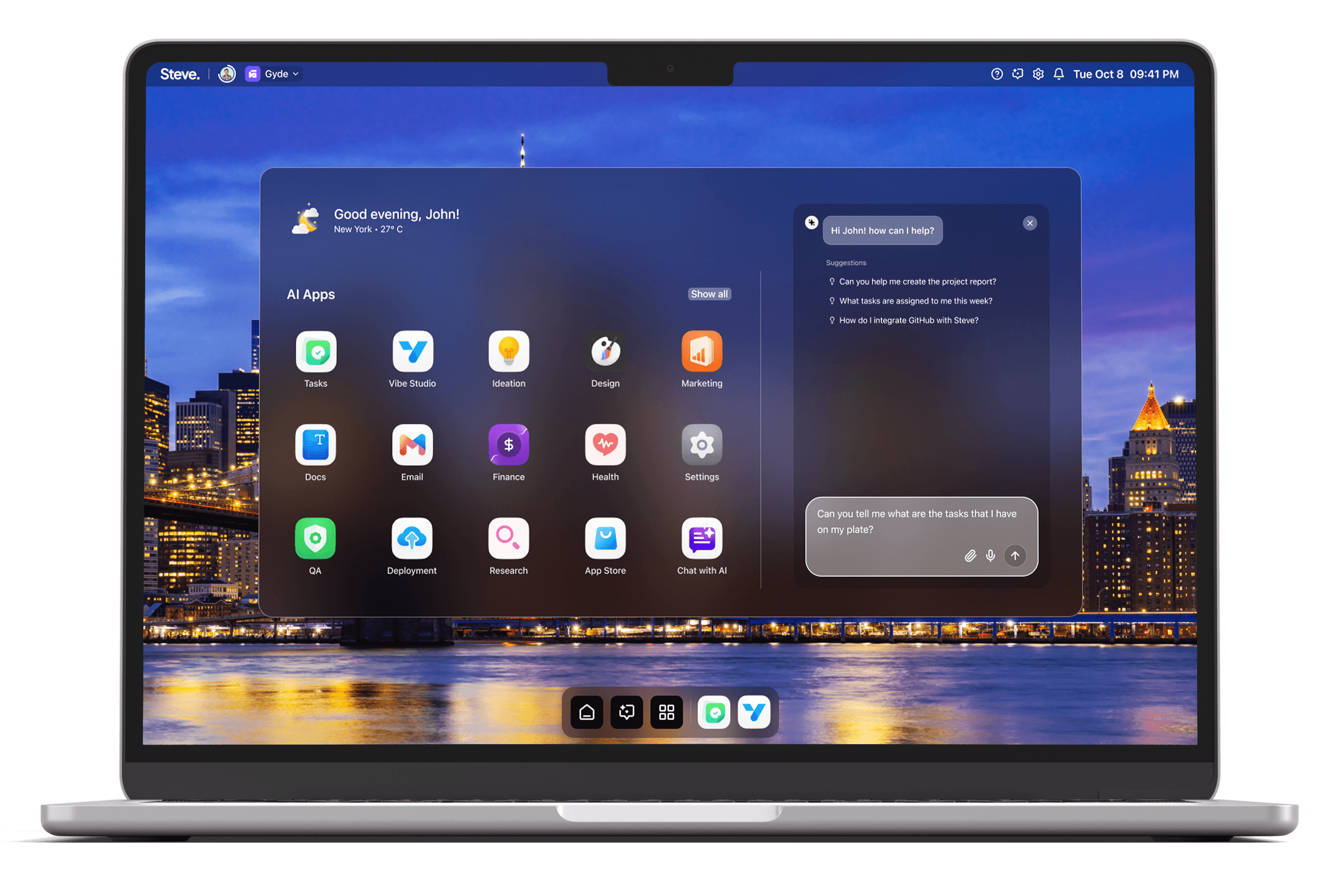
How Steve Functions As An AI Operating System For Modern Businesses
Jan 28, 2026

Unified Context Through Shared Memory: Persistent memory enables agents to collaborate with consistent context, reducing rework and knowledge loss.
Conversational Command and Integration: Steve Chat centralizes commands and connects to 40+ services so natural-language directives trigger coordinated actions.
Communication That Acts: AI Email turns threads into summaries, replies, and tasks so messages lead directly to execution.
Intelligent Task Orchestration: Task Management uses context and integrations to propose sprints, sync with Linear, and streamline planning.
Operational Benefit: Combining memory, chat, email, and tasks reduces tool fragmentation and speeds decision-to-delivery cycles.
Introduction
Modern businesses need an operating layer that combines automation, conversational interfaces, contextual memory, and workflow orchestration. Steve functions as an AI Operating System that unifies communication, knowledge, and execution so teams spend less time switching tools and more time delivering outcomes. Below are the practical ways Steve acts as an AI OS for contemporary organizations.
Unified Context Through Shared Memory
At the center of Steve’s architecture is a shared memory system that lets AI agents interact and produce contextually relevant outputs. Rather than treating each query as isolated, Steve maintains and surfaces prior interactions, documents, and decisions so agents can collaborate on tasks with a consistent context. In practice, this means meeting summaries, project constraints, and document annotations persist across chats and automations—reducing rework and preventing knowledge loss when people hand off work.
For example, when a product requirement is refined in chat, the shared memory records the intent and parameters so downstream automations (email drafts, task creation, or document searches) inherit that context. The result is predictable, aligned outputs across channels without manual syncing.
Conversational Command and Integration
Steve Chat provides a conversational interface that functions as the central control surface for the AI OS. Its memory-aware chat supports scheduling, document retrieval, and cross-app actions via direct integrations with Google Calendar, Gmail, Drive, Sheets, Notion, GitHub, and 40+ services. Users issue natural-language directives—"Prepare the weekly roadmap slide with the latest metrics"—and Steve coordinates data pulls, compiles notes, and prepares artifacts using the same contextual memory.
Because the chat is file-aware and supports real-time web searches, it becomes a single command center for research, synthesis, and execution. Teams rely on Steve Chat to bridge human intent and system actions, eliminating repetitive query patterns and accelerating decision cycles.
Communication That Acts
Steve’s AI Email combines a smart inbox with the AI OS’s conversational and memory capabilities so communication becomes actionable. The inbox automatically tags and prioritizes messages, summarizes long threads, and offers context-aware reply suggestions tied to ongoing projects tracked in shared memory. Users can chat with the AI inside the inbox to refine drafts or generate meeting notes without leaving the conversation flow.
This tight coupling matters because email often contains decisions, requests, and follow-ups that need to convert into work items. With Steve, a flagged thread can yield a concise summary, a proposed reply, and an associated task—all generated or suggested within the same interface—so responses no longer require manual synthesis across tools.
Intelligent Task Orchestration
Steve’s Task Management boards extend the AI OS from information into execution. The platform uses AI to propose sprints, import and sync tasks from Linear, and keep planning and execution in one contextual workspace. Because tasks carry the shared memory context, automation rules can attach relevant documents, status updates, or suggested assignees based on historical behavior and project constraints.
Teams benefit from faster planning and clearer execution: Steve recommends priorities, helps decompose epics into actionable tickets, and keeps status aligned with conversations and email threads. That alignment reduces triage overhead and makes cross-functional coordination smoother without constant manual updates.
Steve
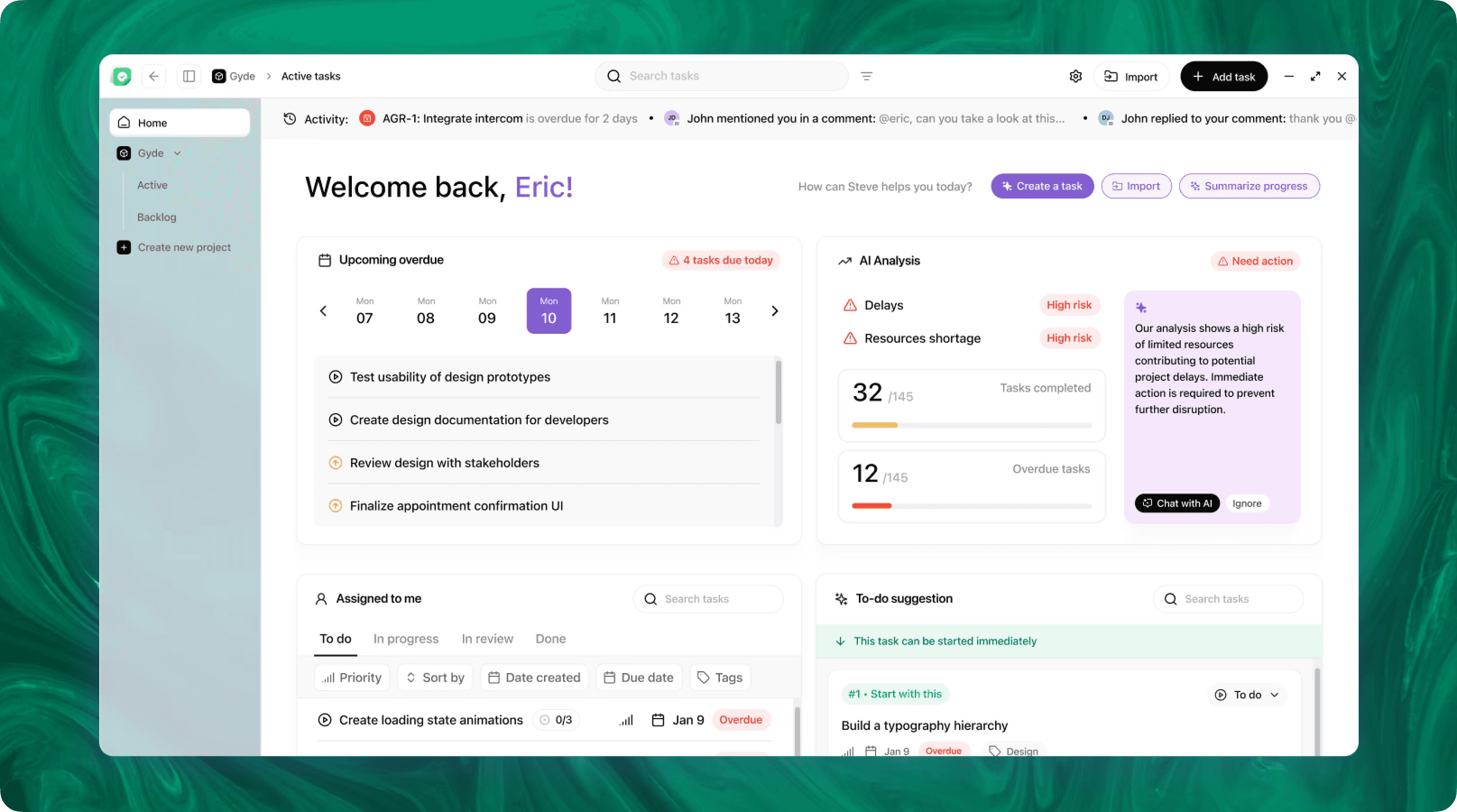
Steve is an AI-native operating system designed to streamline business operations through intelligent automation. Leveraging advanced AI agents, Steve enables users to manage tasks, generate content, and optimize workflows using natural language commands. Its proactive approach anticipates user needs, facilitating seamless collaboration across various domains, including app development, content creation, and social media management.
Conclusion
As an AI OS, Steve combines shared memory, a conversational control layer, a smart inbox, and task orchestration into a single operational plane. The platform reduces context switching, preserves institutional knowledge, and turns communication into executable work—so businesses can move faster with fewer coordination costs. For modern teams, Steve acts less like a single app and more like an intelligent operating layer that aligns decisions, data, and delivery.