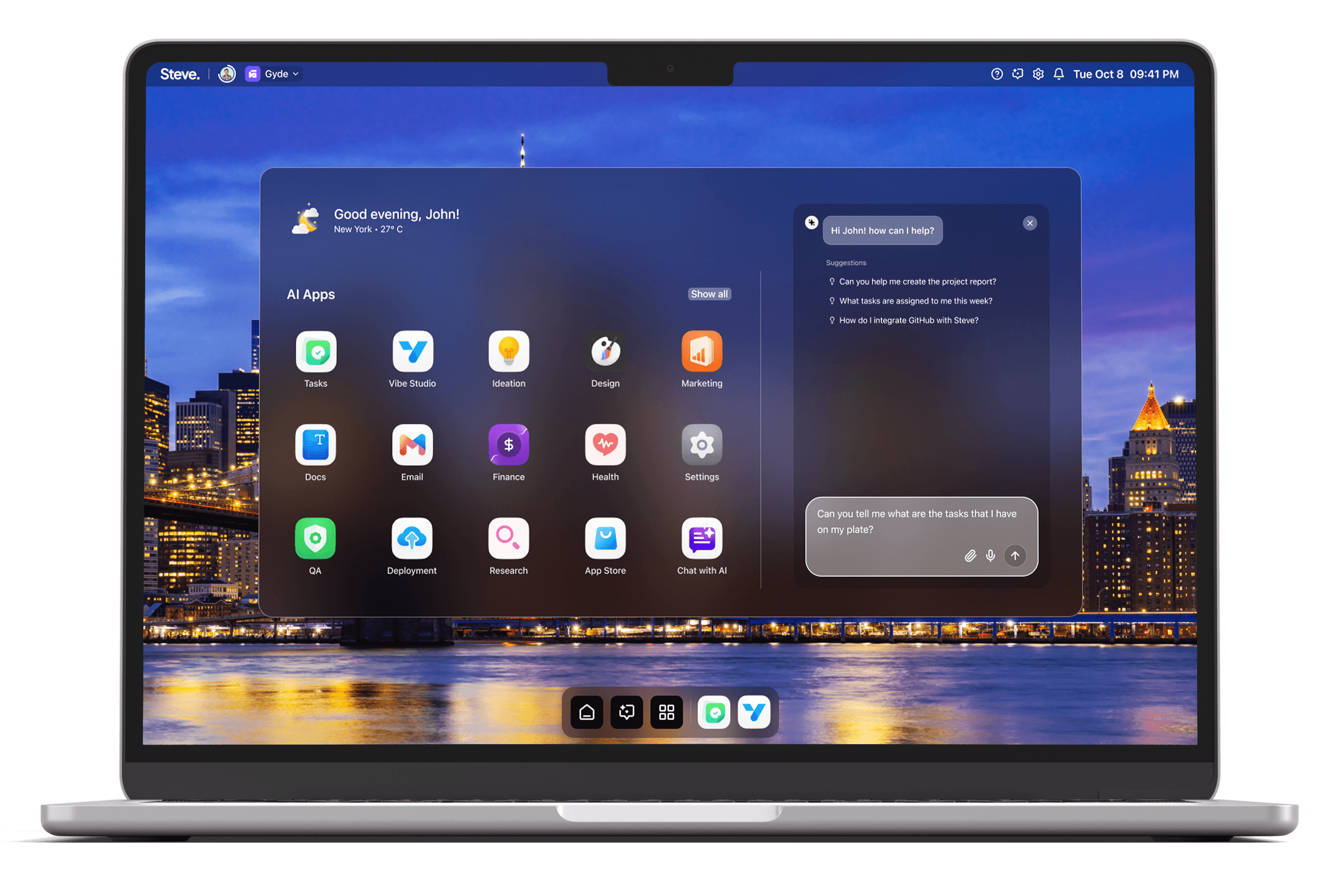
How Steve Enables Scalable Automation Without Complexity
Oct 7, 2026

Shared Memory Enables Reliable Agent Collaboration: Persistent, shared context prevents redundant work and keeps agent outputs consistent across automations.
Conversational Integrations That Drive Automated Workflows: Direct connections to Calendar, Gmail, Drive, GitHub, and 40+ services let users orchestrate cross-system automations through dialog instead of custom middleware.
AI-Powered Task Management For Scale Without Friction: Integrated boards import tasks, propose sprints, and track execution to turn recurring coordination into configurable automation.
AI Email: Automating Communication With Context: A synced smart inbox with tagging, summaries, and reply suggestions streamlines message-driven workflows and triage at scale.
Workflow Benefit: Combining shared memory, conversational integrations, task automation, and smart email reduces orchestration overhead and preserves consistent intent as automation scales.
Introduction
Scaling automation usually increases operational complexity: more bots, more integrations, more failure modes. Steve addresses that challenge by acting as an AI Operating System that centralizes intelligence, context, and execution into a cohesive platform. By combining a shared memory for agents, conversational integrations, AI-native task management, and a smart email layer, Steve reduces orchestration overhead while enabling broad automation across teams.
Shared Memory Enables Reliable Agent Collaboration
A core barrier to scalable automation is fragmented context: separate agents repeat work, overwrite states, or miss prior decisions. Steve’s shared memory system gives AI agents a persistent, queryable context so they can interact, collaborate, and produce outputs that remain consistent across workflows. In practice, this means an invoice-extraction agent, a compliance-check agent, and a reporting agent can reference the same transaction history and annotations rather than rebuilding context from scratch.
Practical scenario: when a finance team launches recurring vendor onboarding automation, shared memory preserves identity verifications, negotiation notes, and approval states. New automations—expense reconciliation, recurring payments, and audit trails—consume that same state without bespoke integration logic, shrinking development and maintenance effort while preventing contradictory behavior.
Conversational Integrations That Drive Automated Workflows
Steve’s chat interface connects directly to Google Calendar, Gmail, Google Drive, Sheets, Notion, GitHub, and 40+ services, letting users orchestrate automations with simple conversation. That conversational surface turns integration complexity into dialog: instead of wiring APIs, a product manager asks Steve to “schedule a rollout, create release notes in Drive, and open tasks in GitHub,” and the platform executes across services with context-aware reasoning.
This lowers the bar for automation because teams no longer need custom middleware for each toolchain. Scheduling, syncing notes, managing issues, and finding documents all become stateful actions in the same conversational flow, enabling faster, repeatable automations such as weekly report distribution or cross-functional incident playbooks.
AI-Powered Task Management For Scale Without Friction
Task Management in Steve consolidates planning, execution, and automation suggestions into a single workspace. The system imports tasks from Linear, proposes sprints, and tracks execution with context-aware automation rules that reflect ongoing work. That removes manual coordination layers and transforms recurring project overhead into configurable AI-driven workflows.
For example, a product team can convert meeting outcomes into a sprint: Steve imports action items from meeting notes, suggests priorities, creates tasks in Linear, and assigns owners. As work progresses, Steve’s context awareness keeps task descriptions current and surfaces dependencies, reducing the need for status meetings and manual triage as the number of projects grows.
AI Email: Automating Communication With Context
Communication scales poorly unless it’s triaged and summarized. Steve’s AI Email integrates a smart inbox with real-time sync, AI tagging, thread summaries, and context-aware reply suggestions, making message-driven automation practical at scale. Teams can rely on compressed summaries and suggested responses to keep workflows moving without reading every thread.
A practical use case: customer support triage. Incoming threads are tagged, summarized, and routed; Steve drafts context-aligned replies and escalates high-priority issues into task boards. The inbox supports up to 500 messages and offers in-place AI chat to refine replies, enabling teams to maintain responsiveness as volume grows without adding headcount.
Steve
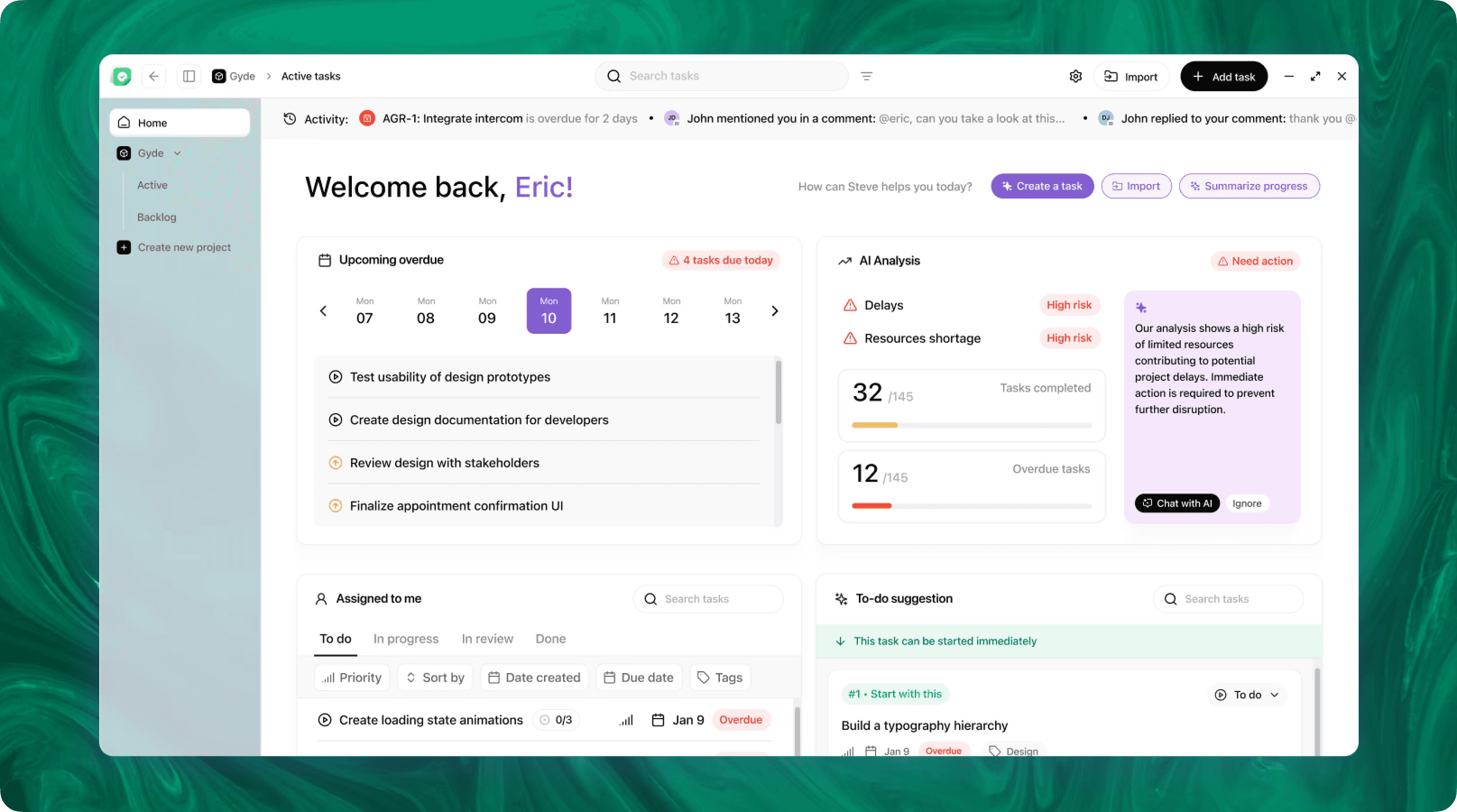
Steve is an AI-native operating system designed to streamline business operations through intelligent automation. Leveraging advanced AI agents, Steve enables users to manage tasks, generate content, and optimize workflows using natural language commands. Its proactive approach anticipates user needs, facilitating seamless collaboration across various domains, including app development, content creation, and social media management.
Conclusion
Scalable automation succeeds when context, integrations, and execution are unified rather than stitched together. As an AI OS, Steve centralizes shared memory for consistent agent behavior, exposes a conversational integration layer to simplify cross-system workflows, embeds AI-aware task management to reduce coordination overhead, and applies smart email automation to tame message volume. The result is scalable automation that minimizes bespoke infrastructure and keeps complexity where it belongs: in configurable, observable rules and shared intelligence rather than fragile point-to-point code.