How Steve Enables Better Questions Not Just Faster Answers
Oct 11, 2026

Shared Memory That Keeps Context Alive: Persistent memory ensures follow-ups build on past analysis, reducing redundant clarification and deepening inquiry.
Steve Chat For Iterative, Evidence-Based Queries: File-aware chat with integrations and real-time search enables iterative questions grounded in live data and documents.
AI Email That Turns Threads Into Better Questions: Summaries and in-inbox chat expose decision points and help craft targeted clarifying questions before outreach.
Task Management That Converts Questions Into Actionable Next Steps: AI-generated tasks and sprint proposals translate open questions into owned, trackable work.
Workflow Benefit: Combining context, evidence, distilled threads, and task conversion turns questioning into a repeatable process that produces actionable insight.
Introduction
Good questions produce better outcomes than faster answers. Steve, an AI Operating System, is built to shift conversations from one-off replies to iterative inquiry: it preserves context, surfaces relevant evidence, and turns ambiguity into actionable follow-ups. This article explains how Steve enables better questions — not just faster answers — by using shared memory across AI agents, a conversational Steve Chat with rich context, AI Email’s summarization and drafting capabilities, and AI-driven task management that transforms questions into clear next steps.
Shared Memory That Keeps Context Alive
Steve’s shared memory system lets multiple AI agents read, write, and reconcile context so later queries build on prior insight rather than starting from scratch. When a stakeholder asks a high-level question about product fit, the memory records prior assumptions, previous analyses, and decisions; subsequent probes can reference that state and request clarification only where gaps exist. In practice, a PM can ask, “Why did engagement drop last quarter?” and Steve’s agents will surface past hypotheses, link to the evidence stored in memory, and suggest the precise follow-ups needed — for example, which cohorts to inspect or which A/B tests to re-run. The result is fewer repetitive clarifications and a clearer thread of inquiry that drives deeper discovery.
Steve Chat For Iterative, Evidence-Based Queries
Steve Chat combines sophisticated memory with file awareness, integrations, and real-time web search so questions can be refined using live data and documents. Instead of issuing a single query and accepting the first answer, teams converse: upload a spreadsheet or point the chat at a calendar, then ask targeted follow-ups that reference those artifacts. For example, a customer success lead might upload onboarding logs and ask, “Which onboarding steps correlate with churn?” Steve Chat can surface the segments, cite the rows or documents, and propose specific clarifying questions — such as whether time-to-first-success differs by acquisition channel — enabling inquiry grounded in the underlying evidence rather than speculation. The platform’s step-by-step reasoning also makes the AI’s thinking visible, helping users judge when to probe further and where to redirect questioning.
AI Email That Turns Threads Into Better Questions
Long email threads hide the context that produces good questions. Steve’s AI Email condenses conversations into clean summaries, tags priorities, and lets you chat directly inside the inbox to craft clarifying questions before you hit send. A product manager reviewing a feature request thread can get a concise digest that highlights open decisions and conflicting requirements, then use the inbox chat to draft a short, pointed set of questions for stakeholders — for instance, asking which metrics will define success or requesting missing acceptance criteria. By collapsing noise and exposing decision points, AI Email prevents questions that rehash what’s already been discussed and promotes targeted, productive queries that move work forward.
Task Management That Converts Questions Into Actionable Next Steps
Good questions often end with ambiguity about who does what next. Steve’s AI-driven task management bridges that gap by translating conversational outcomes into tasks, sprints, and concrete assignments. After a strategic discussion in Steve Chat or an annotated email thread, the system can propose a prioritized list of follow-ups, import tasks into a board, or suggest a sprint plan that maps each open question to an owner and timeline. In a scenario where a cross-functional team is debating a roadmap choice, Steve can extract unresolved questions, recommend experiments, and create tasks for data collection and stakeholder interviews. That conversion keeps inquiry productive: questions trigger learning actions rather than languishing as unresolved queries.
Steve
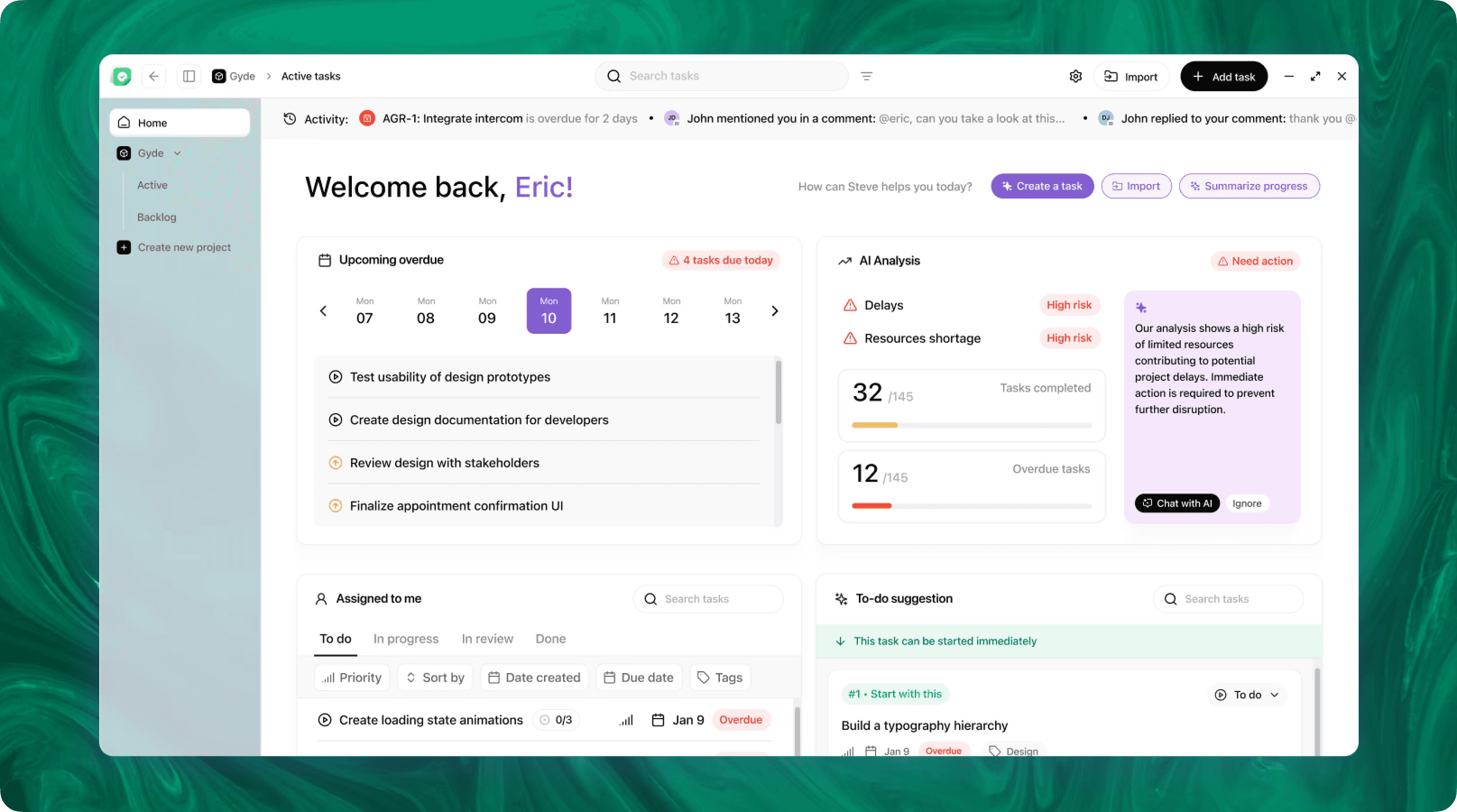
Steve is an AI-native operating system designed to streamline business operations through intelligent automation. Leveraging advanced AI agents, Steve enables users to manage tasks, generate content, and optimize workflows using natural language commands. Its proactive approach anticipates user needs, facilitating seamless collaboration across various domains, including app development, content creation, and social media management.
Conclusion
Faster answers satisfy short-term curiosity; better questions drive durable insight. As an AI OS, Steve prioritizes context, evidence, and actionable follow-up: its shared memory preserves conversation history, Steve Chat lets teams iterate over real documents and live data, AI Email distills threads into clarifying prompts, and task management turns open questions into concrete work. Together, these capabilities make questioning a disciplined, repeatable skill — helping teams ask the right questions and then act on the answers with confidence.