How AI OS Enables Continuous Improvement Culture
Dec 2, 2025

Shared Memory Creates Organizational Learning: Persistent agent memory stores experiments and outcomes so teams iterate from history rather than guesswork.
Conversational Feedback Drives Iteration: Steve Chat converts conversations and attachments into context-aware summaries and actionable recommendations.
AI-Powered Task Management Embeds Improvement Cycles: Automated task creation and sprint proposals close the loop between insight and execution.
Email Intelligence Captures External Signals: AI Email extracts trends and priorities from customer threads and surfaces them into planning workflows.
Unified Platform Accelerates Repeatability: Combining memory, chat, task boards, and email into one AI OS makes continuous improvement observable and scalable.
Introduction
Continuous improvement is a discipline: deliberate cycles of feedback, learning, and adjustment that keep teams adaptive. An AI Operating System changes how those cycles run by making context, communication, and actionable work visible and repeatable. As an AI OS, Steve combines a shared memory for agents, conversational intelligence, task automation, and inbox-level synthesis to turn sporadic improvements into sustained practice.
Shared Memory Creates Organizational Learning
Continuous improvement depends on institutional memory: decisions, experiments, and outcomes must persist so teams learn from history instead of repeating mistakes. Steve’s shared memory system lets AI agents read, write, and surface that context across conversations and tools. Practically, this means a product experiment logged in Steve Chat — metrics, hypotheses, and outcomes — becomes a retrievable artifact that informs future prompts, task proposals, and automated suggestions.
For example, after a UX A/B test, Steve can retain the experiment brief, the metric deltas, and stakeholder notes in shared memory; when a PM later asks for a rollout plan, Steve uses that history to recommend guardrails and roll-forward rules. That continuity accelerates learning loops: insights travel from discovery to execution without manual handoffs, and the AI OS enforces traceability of what was tried and why.
Conversational Feedback Drives Iteration
Conversation is how teams surface problems and propose changes. Steve Chat provides a conversational interface with persistent memory and deep integrations (Google Calendar, Drive, Sheets, Notion, GitHub and 40+ services), turning casual inputs into executable records. Teams can discuss a performance regression in chat, attach a log or spreadsheet, and ask Steve to summarize root causes, propose remediation steps, or open retrospective tasks.
A practical scenario: an engineer reports CPU spikes in a chat thread and uploads monitoring charts. Steve ingests the files, searches relevant docs, and summarizes probable causes, then links to prior incidents stored in shared memory. Because the AI OS connects conversation to context and past fixes, recommendations are not blind guesses but context-aware actions that speed iteration.
AI-Powered Task Management Embeds Improvement Cycles
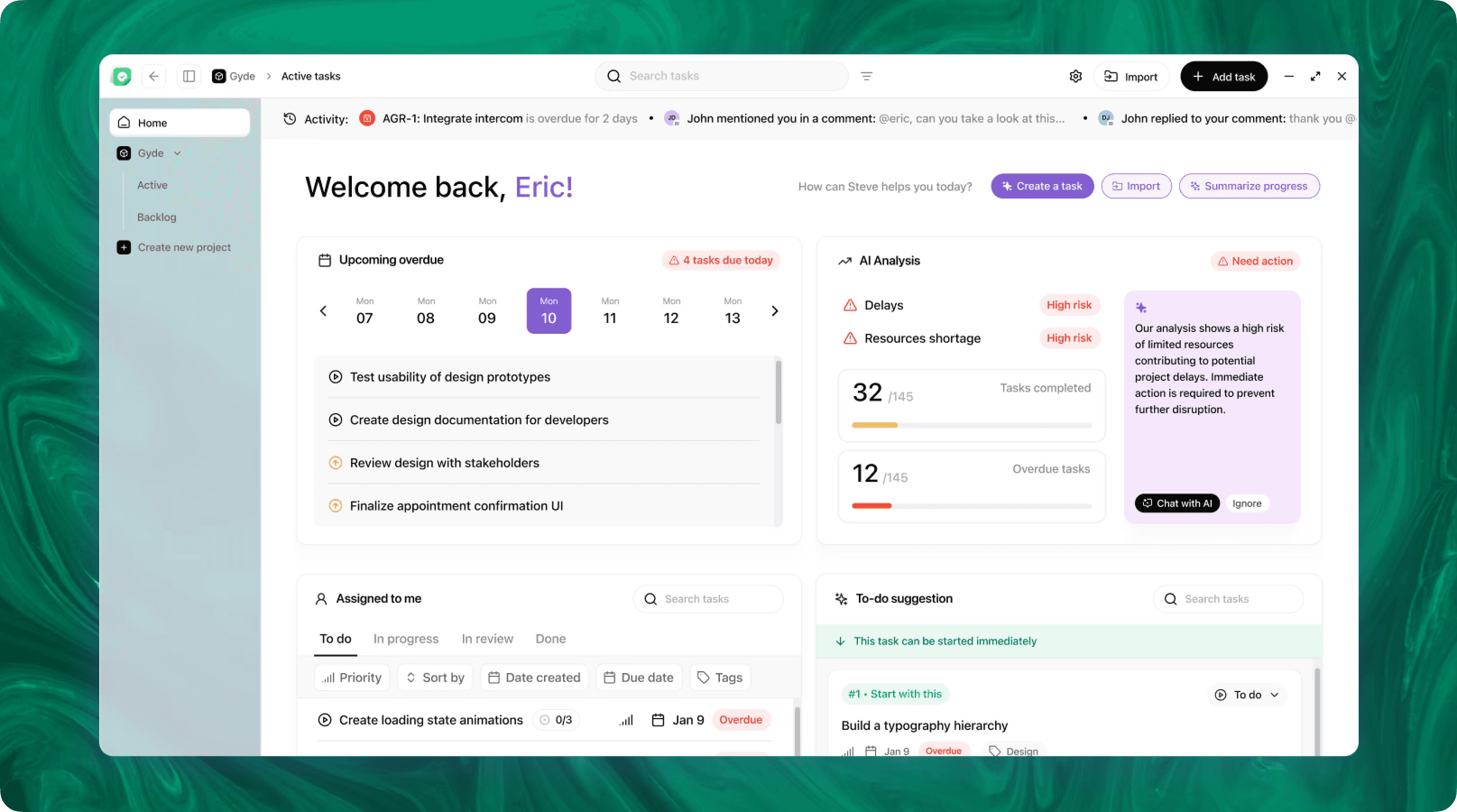
Continuous improvement requires turning insight into work. Steve’s Task Management boards—integrated with tools like Linear—automate that translation by proposing sprints, creating tasks from prompts, and tracking execution in a single workspace. The AI OS recommends priorities based on context, suggests owners, and updates progress as related conversations evolve.
In practice, after a postmortem chat, Steve can generate a set of prioritized tasks, estimate effort bounds, and propose a sprint cadence; teams accept, adjust, and let Steve track completion and feed results back into shared memory. That closes the loop: learnings spawn concrete work, and outcomes update the organizational knowledge base so future cycles start from a stronger baseline.
Email Intelligence Captures External Signals
External feedback—customers, partners, suppliers—often arrives by email and can be a rich source for improvement. Steve’s AI Email integrates the inbox with real-time sync, AI tagging, thread summaries, and context-aware reply suggestions so signals don’t languish in unread mail. Summaries surface trends across threads; tags prioritize recurring complaints or feature requests for rapid triage.
A customer success manager can ask Steve to summarize a week’s worth of product feedback threads; the OS extracts common requests, flags regressions, and drafts prioritized escalation notes for the product board. Because Steve links these summaries back into shared memory and the task board, external signals automatically seed the next improvement cycle rather than becoming isolated anecdotes.
Steve
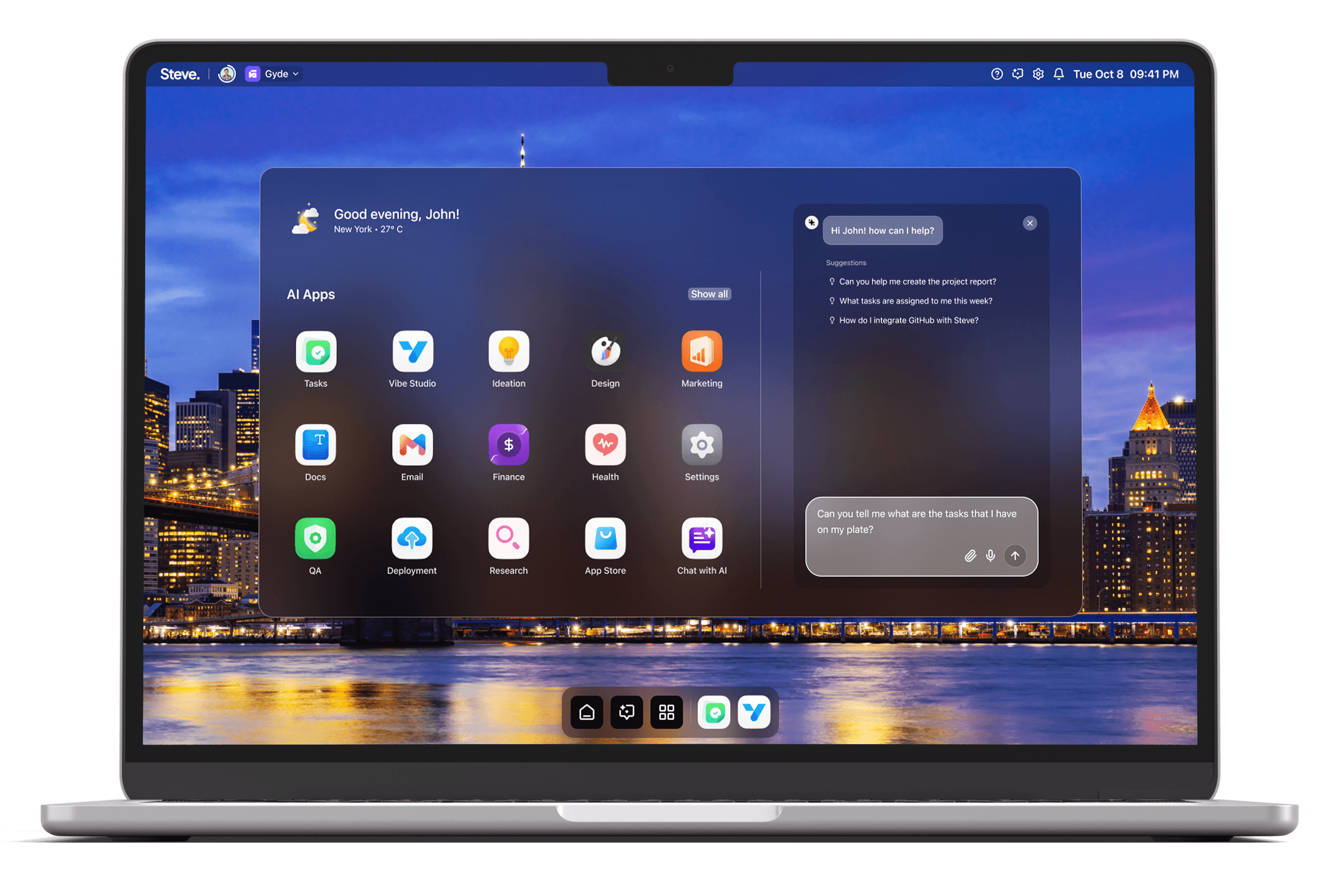
Steve is an AI-native operating system designed to streamline business operations through intelligent automation. Leveraging advanced AI agents, Steve enables users to manage tasks, generate content, and optimize workflows using natural language commands. Its proactive approach anticipates user needs, facilitating seamless collaboration across various domains, including app development, content creation, and social media management.
Conclusion
An AI OS makes continuous improvement operational by preserving institutional memory, turning conversations into context-aware action, automating the creation and tracking of improvement work, and capturing external signals from email. Steve bundles those capabilities into a unified platform: shared memory sustains learning, Steve Chat gathers and contextualizes feedback, Task Management converts insight into execution, and AI Email ensures external input is visible and actionable. The result is a repeatable, observable improvement loop that scales with the organization.