Conversational Business Modeling for Strategy Teams
Jan 13, 2026

Conversational Modeling With Persistent Context: Shared memory plus Steve Chat preserves and evolves assumptions so teams iterate models without losing provenance.
Collaborative Scenario Building And Evidence: Steve ingests files and uses real-time search to synthesize evidence directly into scenario comparisons.
Stakeholder Alignment And Documentation: AI Email produces concise summaries and context-aware drafts that accelerate stakeholder buy-in.
Translating Models Into Execution: Task Management converts conversational conclusions into prioritized tasks and sprint plans to close the loop.
Workflow Benefit: Combining persistent context, evidence synthesis, aligned communication, and execution tracking keeps strategy active and traceable.
Introduction
Conversational business modeling reframes strategy work as a dynamic dialogue instead of a linear document exercise: teams iterate assumptions, test scenarios, and surface risks through natural language interaction. For strategy teams, that reduces misalignment, compresses decision cycles, and preserves the rationale behind choices. As an AI Operating System, Steve provides the conversational infrastructure, persistent context, and execution hooks that let strategy teams model businesses, validate trade-offs, and translate conclusions into coordinated action without leaving the conversation.
Conversational Modeling With Persistent Context
Strategy modeling depends on a running set of assumptions—market size, price sensitivity, unit economics—that change during discussion. Steve’s shared memory and Steve Chat combine so conversations retain and evolve those assumptions: the platform remembers prior inputs, links them to later queries, and surfaces relevant context when participants revisit a topic. In practice, a strategy lead can state baseline assumptions in chat (e.g., CAC, LTV, churn) and then iteratively ask for sensitivity analyses; Steve preserves prior values, computes differences across iterations, and documents what changed and why.
A typical scenario: during a planning session, a product strategist proposes three pricing tiers and asks Steve to model revenue under varying adoption curves. Because the chat thread and shared memory store the parameter set, the team can ask follow‑ups—“show the same model with a 20% higher churn”—and receive immediate, context-aware responses that cite the original assumptions. That traceability keeps debates evidence-driven and reduces rework when revisiting decisions weeks later.
Collaborative Scenario Building And Evidence
High-quality strategy requires data and documents: market research, competitor decks, spreadsheets, and presentation drafts. Steve Chat is file-aware and supports real-time web searches, so teams can fold documents and live data into conversational models. Upload a competitor pricing spreadsheet or link a market survey, and Steve ingests salient figures, summarizes implications, and applies them to the scenario under discussion.
For example, a strategist tests a new go‑to‑market motion and asks Steve to reconcile survey uptake rates with historical sales funnels. Steve extracts relevant metrics from uploaded spreadsheets, supplements gaps via real-time web lookups, and returns a synthesis that identifies where assumptions clash with evidence. That synthesis becomes the basis for what-if branches in the model, enabling teams to compare scenario outcomes side-by-side without manual aggregation.
Stakeholder Alignment And Documentation
Strategy decisions only deliver value when stakeholders understand and accept trade-offs. Steve’s AI Email capabilities accelerate alignment by generating concise summaries of long threads, drafting context‑aware updates, and tagging key decisions for visibility. After a modeling session, the strategy lead can ask Steve to produce a one‑page memo capturing the final assumptions, scenario outcomes, and recommended next steps—Steve summarizes long conversations into a focused message that can be sent or refined in the same interface.
A practical use case: following a cross-functional review, Steve drafts an email that highlights the agreed pricing tier, expected revenue ranges, and required product changes; it also attaches the underlying chat thread and key documents. That reduces ambiguity and ensures downstream teams act on the same model rather than disparate recollections.
Translating Models Into Execution
Modeling without execution creates good-looking artifacts that go stale. Steve closes that loop with integrated task management: turn conversational conclusions into prioritized tasks, create sprints, and track progress without rebuilding context. Strategy teams can convert action items from the chat directly into tasks, assign owners, and let Steve propose sprint plans that reflect dependencies and timing.
In a scenario where the model mandates a pricing experiment, Steve can spawn a set of tasks—for product changes, analytics tracking, and marketing experiments—and suggest an initial sprint timeline. Integration with existing issue trackers and the AI OS memory keeps the relationship between the original assumptions and execution artifacts visible, so progress updates remain tied to the model they validate.
Steve
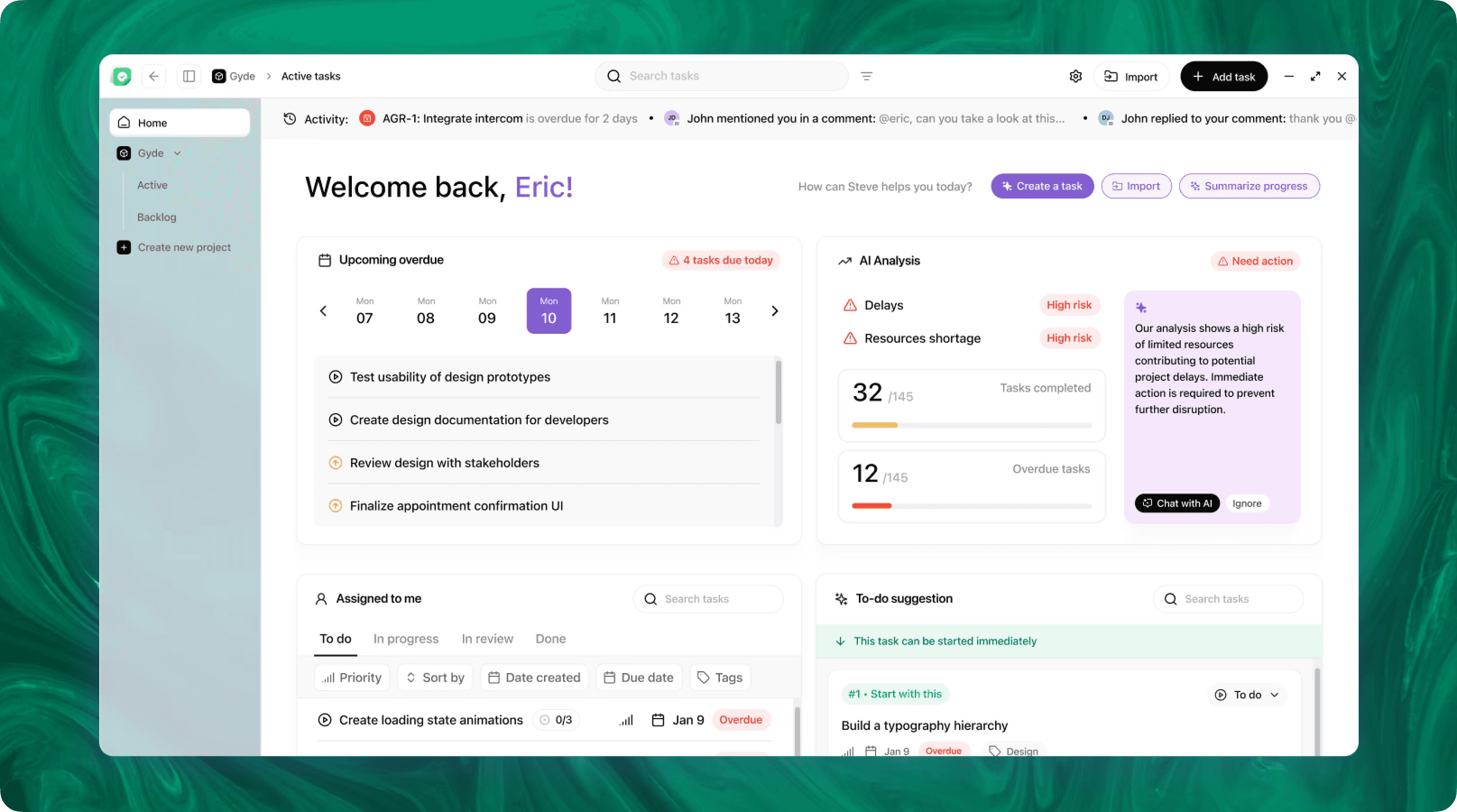
Steve is an AI-native operating system designed to streamline business operations through intelligent automation. Leveraging advanced AI agents, Steve enables users to manage tasks, generate content, and optimize workflows using natural language commands. Its proactive approach anticipates user needs, facilitating seamless collaboration across various domains, including app development, content creation, and social media management.
Conclusion
Conversational business modeling makes strategy both faster and more defensible when the platform preserves context, ingests evidence, aligns stakeholders, and pushes outcomes into execution. As an AI OS, Steve provides those capabilities: persistent shared memory and a file‑aware chat for continuous modeling, AI Email for concise alignment, and task management to convert conclusions into tracked work. The result is a single conversational workflow that captures intent, validates it against data, and drives coordinated action—keeping strategy live rather than archived.