Building Enterprise Knowledge Graphs Inside Steve
Dec 3, 2025

Shared Memory As The Single Source For Entities: Persistent shared memory creates canonical entities and consistent context across AI agents, reducing duplication and enabling reliable entity resolution.
Ingesting And Linking Across Integrated Sources With Steve Chat: Direct integrations and file-aware agents let Steve extract entities and relationships from documents, code, spreadsheets, and web sources without custom connectors.
Turning Email Signals Into Temporal And Relational Nodes: AI Email’s summaries and tags convert conversational decisions and deadlines into graph nodes with provenance and temporal context.
Operationalizing Graphs Through Tasks, Workflows, And Logging: Task Management and LangFuse chat logs turn graph insights into actionable work and produce audit trails that refine extraction heuristics.
Workflow Benefit: Combining persistent context, integrated ingestion, conversation-aware extraction, and operational hooks makes knowledge graphs practical and maintainable inside an AI OS.
Introduction
Building enterprise knowledge graphs inside Steve turns scattered organizational signals into connected, queryable assets that accelerate search, decision-making, and automation. As an AI Operating System, Steve brings conversational agents, persistent shared memory, rich integrations, and workplace-aware automation into a single environment—allowing teams to extract entities, link relationships, and maintain provenance without stitching together separate tools. This article shows practical patterns for assembling and operationalizing enterprise knowledge graphs inside Steve.
Shared Memory As The Single Source For Entities
Steve’s shared memory system lets multiple AI agents read, write, and enrich the same contextual store, creating a practical backbone for canonical entities and relationships. Instead of isolated model outputs saved in siloed files, agents annotate people, projects, documents, and code references into the shared memory so later interactions preserve referential integrity and context. In practice, a legal agent can add contract clauses as structured nodes while a product agent links those clauses to feature specifications; subsequent queries reference the unified memory rather than reconciling conflicting labels. That persistent, agent-accessible state reduces duplication, accelerates entity resolution, and provides a single truth that underpins graph construction.
Ingesting And Linking Across Integrated Sources With Steve Chat
Steve Chat’s direct integrations with Google Drive, Gmail, Google Sheets, Notion, GitHub and 40+ services — combined with file-aware uploads and real-time web search — provide a rich, diverse corpus for entity extraction and relationship discovery. Agents can pull documents, read spreadsheets, inspect code repositories, and surface web references inside the same conversational context, then map extracted entities into the shared memory. A practical scenario: building a product knowledge graph that links roadmap items (from Sheets), design documents (from Drive), implementation tickets (from GitHub), and stakeholder notes (from Notion); Steve Chat facilities let agents traverse those sources, extract structured metadata, and propose candidate edges without developers writing bespoke connectors. Because agents operate conversationally, domain experts can validate entity mappings inline, keeping human review part of the ingestion loop.
Turning Email Signals Into Temporal And Relational Nodes
Email often contains decisions, timelines, and stakeholder commitments that belong in a knowledge graph but are hard to surface. Steve’s AI Email module tags, summarizes, and categorizes threads in real time, producing condensed decision artifacts that agents can transform into graph nodes and time-stamped relationships. For example, an AI Email summary can produce a “go/no-go” decision node linked to a project node, or extract a deadline and attach it as a temporal property. Because Steve permits conversational interaction inside the inbox, teams can refine extracted entities and relationships immediately—clarifying ambiguity before the data reaches the graph. This preserves provenance (which email generated the node), supports auditability, and keeps the graph aligned with ongoing communications.
Operationalizing Graphs Through Tasks, Workflows, And Logging
Knowledge graphs deliver value when they tie into execution. Steve’s Task Management boards and Linear integration let teams convert graph-derived insights into actionable work: create issue nodes that reference graph entities, schedule remediation sprints that prioritize nodes with high risk, or generate task templates from recurring relationship patterns. Meanwhile, LangFuse-based chat logging (available through Steve Chat) captures interaction traces and extraction decisions, producing analytics that help refine entity extraction rules, relationship heuristics, and agent prompts. In an operational workflow, agents propose graph updates after a discovery pass, product owners approve changes via task cards, and engineers implement follow-ups—creating a closed loop where the graph informs work and work updates the graph.
Steve
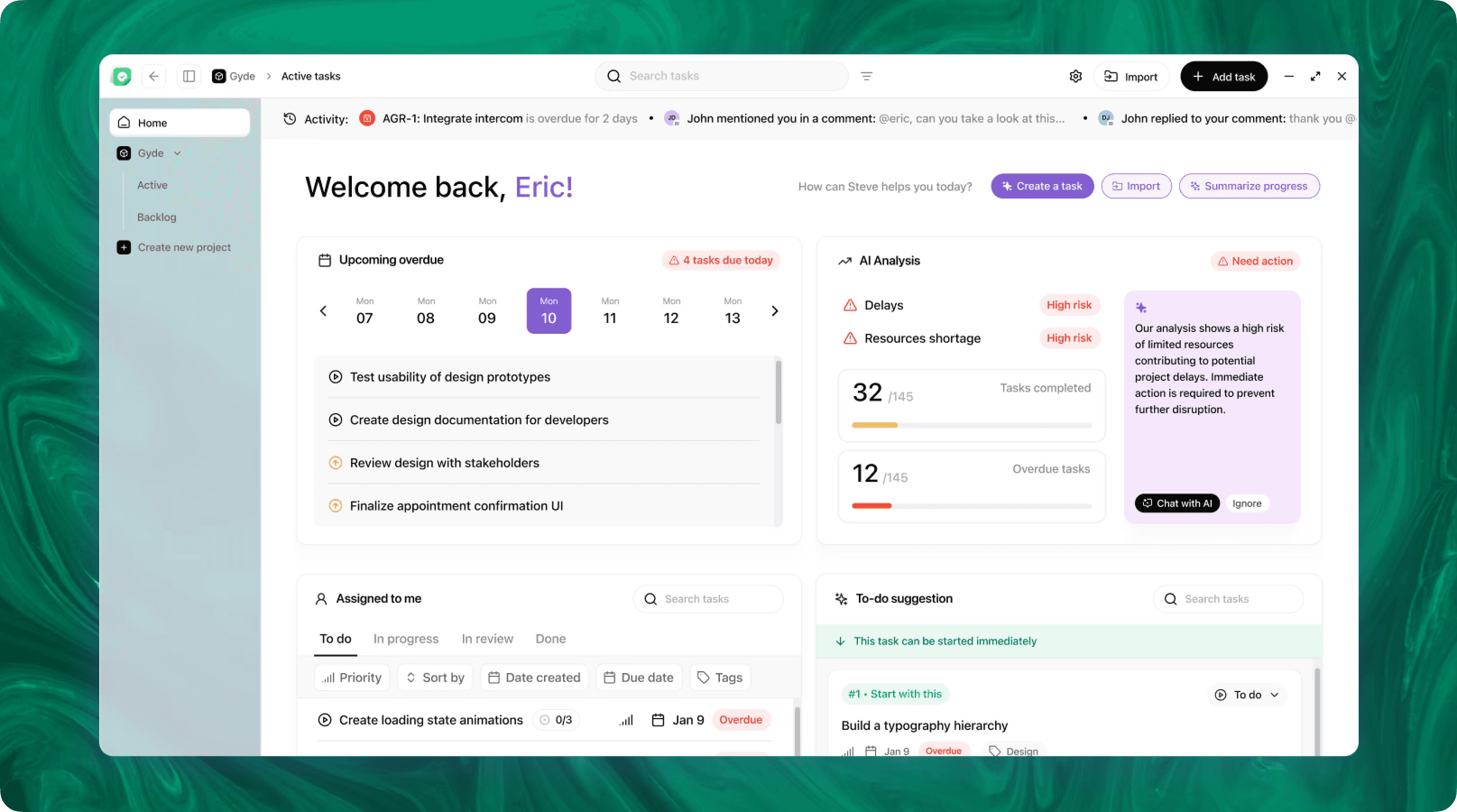
Steve is an AI-native operating system designed to streamline business operations through intelligent automation. Leveraging advanced AI agents, Steve enables users to manage tasks, generate content, and optimize workflows using natural language commands. Its proactive approach anticipates user needs, facilitating seamless collaboration across various domains, including app development, content creation, and social media management.
Conclusion
Constructing enterprise knowledge graphs inside Steve relies on assembling persistent context, broad ingress points, communication-aware extraction, and operational hooks for execution and auditing. Steve’s shared memory anchors canonical entities, Steve Chat supplies integrated source access and file-aware extraction, AI Email turns conversations into graph-worthy artifacts, and task boards plus logging operationalize and refine the graph over time. As an AI OS, Steve does not replace graph databases; it supplies the conversational, contextual, and integrative infrastructure teams need to build practical, maintainable knowledge graphs that accelerate discovery and decision-making.