Building A Retirement-Proof Knowledge Base With Steve
Nov 20, 2026

Persistent Memory That Guards Institutional Knowledge: Shared memory captures decisions, rationale, and relationships so context survives personnel changes.
Turn Conversations And Email Into Trusted Knowledge Artifacts: AI Email auto-summarizes and tags threads, converting ephemeral exchanges into searchable entries linked to memory.
Link Knowledge To Workflows And Ownership: Task Management turns stale documentation into assigned tasks, ensuring updates are scheduled and tracked.
Searchable, Conversational Access Across Contexts: Steve Chat lets users retrieve context-rich answers that reference documents, emails, and past discussions.
Operational Benefit: Combining memory, email capture, task linking, and conversational access produces a living knowledge base that accelerates onboarding and reduces knowledge loss.
Introduction
Building a retirement-proof knowledge base is about more than storage: it requires continuous capture, context-aware retrieval, and seamless handoff between people and systems. Steve, an AI Operating System, is designed to keep institutional knowledge alive by combining persistent agent memory, conversational access, and automation that ties knowledge to action. This article explains how to design a knowledge base that resists decay and personnel turnover using Steve's core capabilities.
Persistent Memory That Guards Institutional Knowledge
A knowledge base is only retirement-proof when it retains context, not just files. Steve’s shared memory system lets AI agents interact, collaborate, and maintain a single, evolving record of decisions, definitions, and project histories. Instead of isolated notes or folders, the memory stores relationships — who made a decision, why alternatives were rejected, and which documents informed the outcome.
Practical scenario: when a senior engineer documents an architecture decision in conversation with Steve, that conversation is captured in shared memory along with linked design artifacts and rationale. Later, a new hire querying Steve receives an explanation that includes the original decision context, linked documents, and subsequent changes, preserving intent that would otherwise evaporate in handoffs.
Turn Conversations And Email Into Trusted Knowledge Artifacts
Critical institutional knowledge often lives in email and threaded conversations. Steve’s AI Email features — automated tags, thread summaries, and context-aware draft suggestions — convert these ephemeral exchanges into searchable knowledge artifacts without forcing manual curation.
Practical scenario: after a cross-team negotiation over API versioning, Steve automatically tags the thread, extracts a concise summary of outcomes and action items, and stores that summary in shared memory alongside the original thread. When someone later asks about the API policy, Steve surfaces the summary, the email thread, and the responsible owner, eliminating the need to search through inboxes and interpret long threads.
Link Knowledge To Workflows And Ownership
A retirement-proof knowledge base must connect information to accountable work. Steve’s Task Management capabilities create that bridge: knowledge entries can spawn tasks, suggest owners, and feed into sprint planning so institutional knowledge continuously updates through execution.
Practical scenario: an onboarding document flagged outdated dependencies; Steve proposes a remediation task, assigns it to the appropriate engineering lead, and schedules the update into the next sprint. The task references the original document version in shared memory, and the board tracks completion. That closed loop keeps documentation current and ties knowledge preservation to tangible outcomes rather than passive storage.
Searchable, Conversational Access Across Contexts
Storing knowledge is insufficient if people can’t retrieve it naturally. Steve Chat provides conversational, file-aware access with sophisticated memory and integrations, so users can ask plain-language questions and receive context-rich, evidence-backed answers that reference files, calendar items, and past discussions.
Practical scenario: a product manager asks Steve, “Why did we choose optimistic concurrency in billing?” Steve Chat pulls the decision note from shared memory, attaches the original design document and relevant email summarizations, and explains the trade-offs recorded at the time. If new information exists — an updated performance report or a related ticket — Steve surfaces that too, allowing the manager to make an informed judgment without hunting through multiple systems.
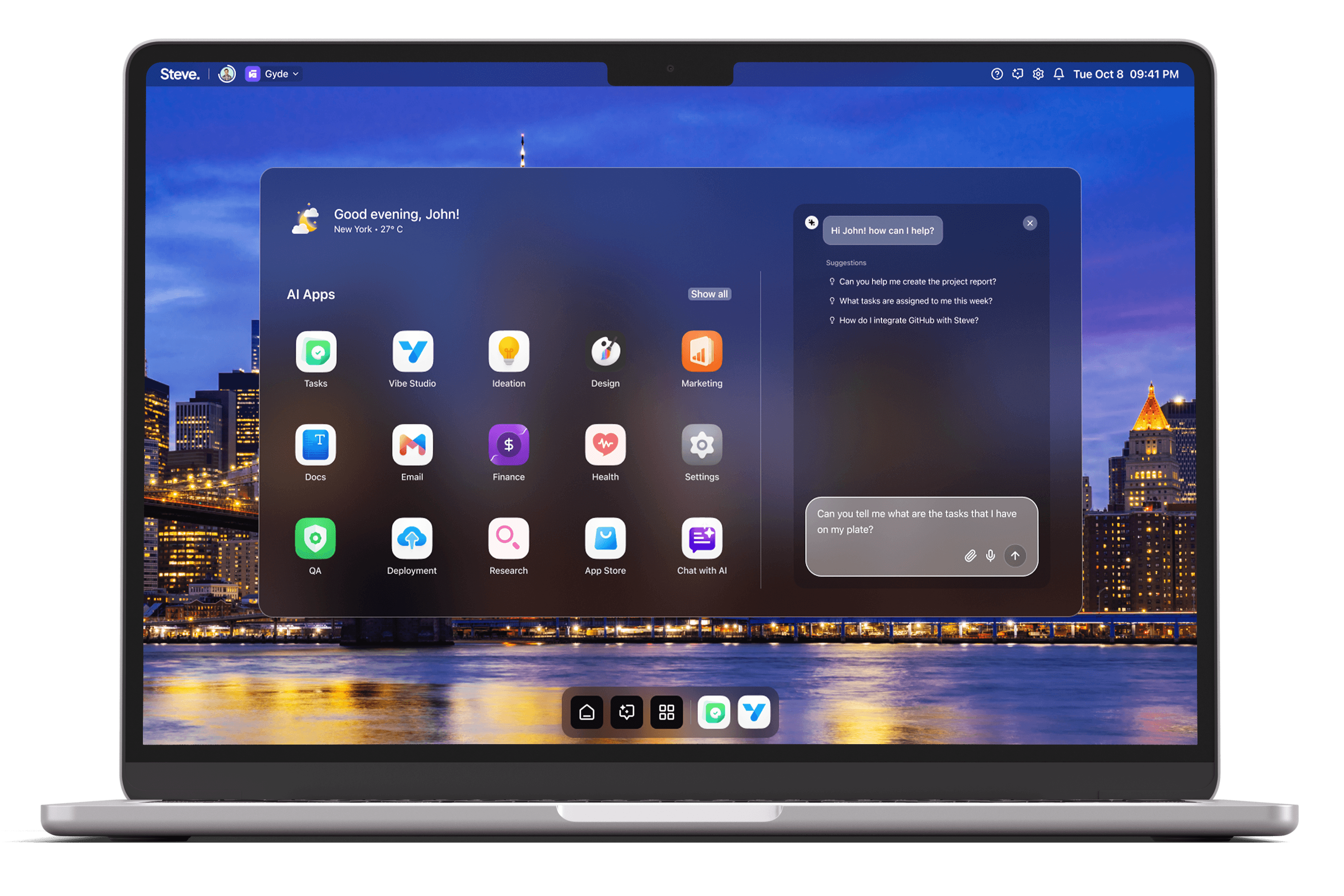
Steve

Steve is an AI-native operating system designed to streamline business operations through intelligent automation. Leveraging advanced AI agents, Steve enables users to manage tasks, generate content, and optimize workflows using natural language commands. Its proactive approach anticipates user needs, facilitating seamless collaboration across various domains, including app development, content creation, and social media management.
Conclusion
A retirement-proof knowledge base requires persistent contextual memory, automated capture of conversational and email knowledge, operational links to tasks and owners, and natural conversational retrieval. As an AI OS, Steve brings these capabilities together: shared memory preserves intent, AI Email turns conversations into searchable artifacts, Task Management ties knowledge to action, and Steve Chat provides conversational access that connects documents, decisions, and people. The result is a living knowledge base that survives turnover, accelerates onboarding, and keeps institutional wisdom usable over time.